

CHESAPEAKE BAY - Researchers have published a nearly 40-year study documenting just how prevalent cannibalism is in the Chesapeake Bay’s blue crab population and how protecting shallow-water habitat could play a vital role in sustaining the Bay’s most iconic crustacean.
While blue crabs are known to be notoriously cannibalistic, research into just how common it is has been scarce, according to the Smithsonian Environmental Research Center. Scientists set out to discover what exactly was eating young blue crabs, and in 1989, marine biologist Tuck Hines began his study in the Rhode River in Edgewater, Md.
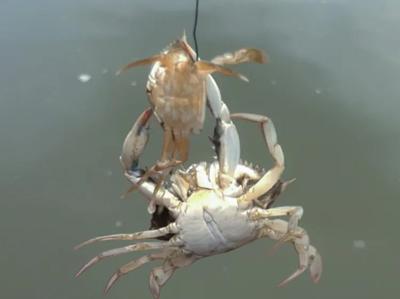
SERC says Hines’ team attached juvenile crabs to small metallic tethers that would allow the young crustaceans to move around and also hide themselves in the river’s sediment. By burying themselves, juveniles are able to hide from predatory fish, but are still at risk of being detected by larger crabs. After placing the tethered crabs, researchers returned 24 hours later to see how the juveniles fared.
According to the study, published on March 16, about 74% of the crabs survived, but 42% were either injured or killed by larger crabs. The scientists say they found no evidence of fish predators, suggesting the mid-salinity rivers feeding into the Chesapeake offer refuge from predators like striped bass.
“We were amazed to find that over our 37-year study, cannibalism accounted for all of the predation, and we found no fish predation on tethered crabs,” Hines said.
Scientists say the smallest crabs were more than twice as likely to be eaten than their medium or large juvenile counterparts. But the researchers found that the shallower the water, the safer the smaller crabs would be.
“In the experiment, a small juvenile crab was 60–80% likely to get eaten in deeper waters (1.3 to 2.5 feet deep),” SERC writes. “But in the shallowest zones (15 centimeters or a half-foot), they were only about 30% likely to be cannibalized. This rule of safety in the shallows held true for larger juveniles as well.”
According to researchers, the findings of this study will help inform new stock-assessment models for the Chesapeake blue crabs, as well as underscore the importance of protecting shallow-water refuges. SERC says seawalls, riprap, and other shoreline-hardening projects are encroaching on nearshore territory, making smaller juvenile crabs more susceptible to cannibalism.
Protecting and restoring those habitats, the authors of the study say, will be critical in stabilizing the blue crab population and protecting the fishery.