
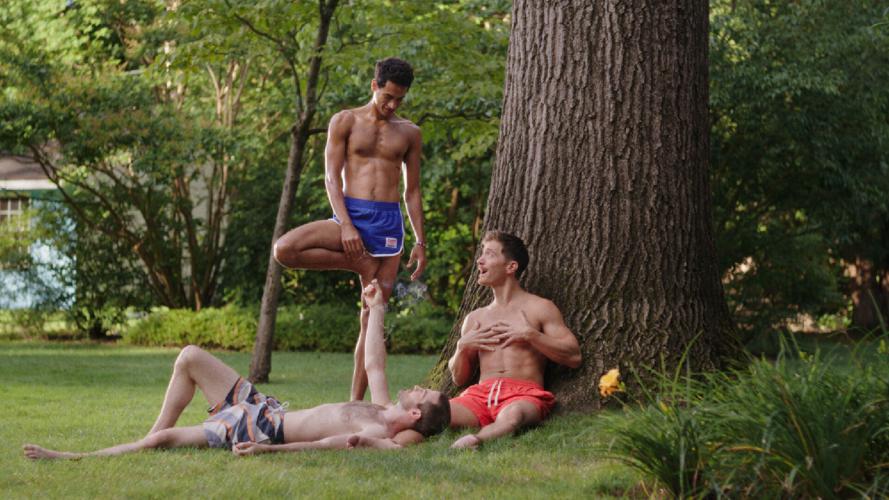




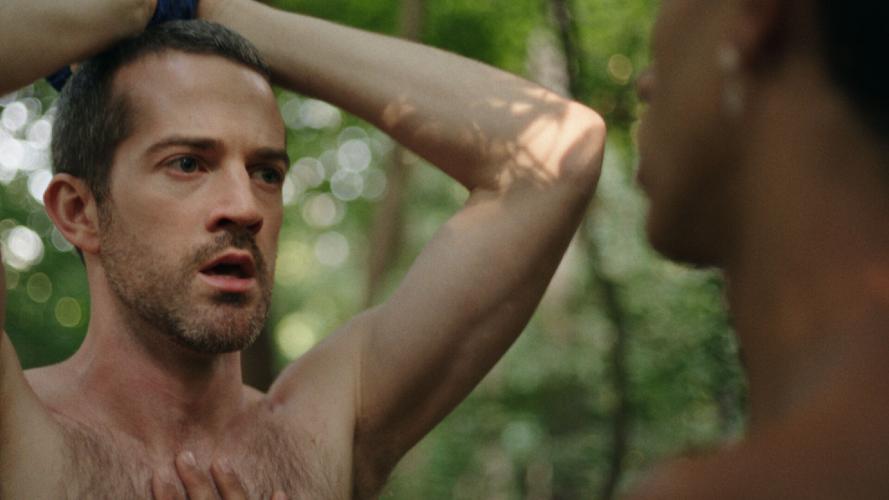

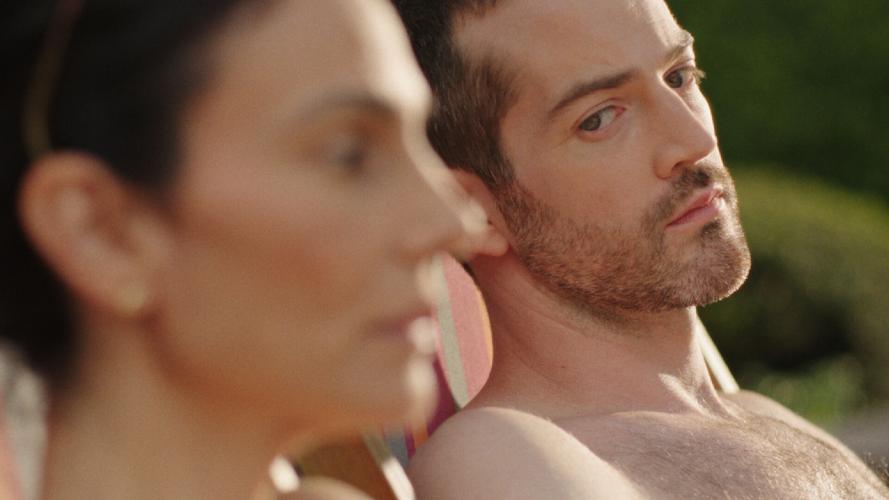



This is the fifth feature from writer-director Alan Brown whose first feature was Book of Love (2005), which was about a romantic couple who has a young man come in between them, having an affair with one of them. That young man was a swimmer, so there were a lot of shots of that character in a swimming pool. Brown's third feature was Private Romeo (2012), which was a queer reimagining of William Shakespeare's Romeo and Juliet (1597). His fourth and previous feature was Five Dances (2013), which was about a romance between members of a dance company in New York City. With this film, Brown seemingly combines elements of all those features he made. The subject here again focuses on a romance between members of a dance company. The structure here again is a queer reimagining of someone else's work. Instead of Shakespeare, it's a queer reimagining of Jacques Deray's La Piscine (1969), which is about a group of friends who spend the summer together where a lot of consequential things occur next to a swimming pool. Finally, like Book of Love, the plot here again is about a couple who has a young man come in between them, having an affair with one of them, or in this case, more than one of them.
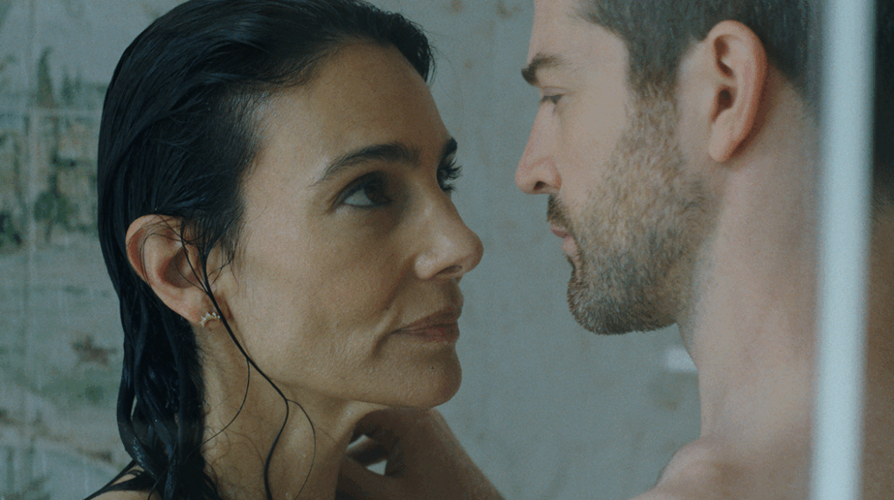
Annie Parisse (Daredevil: Born Again and Law & Order) stars as Olivia, the head of a dance company in New York City. She's planning on stepping down and letting someone else take over as the head of the company. One of the reasons is perhaps her age. She is likely in her late 40's, early 50's. One of the other reasons is probably the fact that she was diagnosed with cancer, specifically leukemia, which would most definitely affect her ability to be a dancer. Her physical body and her ability to be physical with her body are how she makes her living and her art. That's potentially being taken away from her. She's constantly talking about the youth and vitality of others, in terms of their bodies, so clearly a theme here is that kind of jealousy, which for her also manifests as a kind of nostalgia for what she used to be able to do that she won't be able to do for much longer. Parisse's performance sells that to some degree, but Brown's film doesn't delve into that to make it truly an effective aspect.

A.J. Shively is a Tony Award nominee and is known more for his 25-year career on Broadway. Here, Shively plays Sebastian or "Seb," a computer programmer that works on large language models for artificial intelligence systems. On paper, he seems like he is this big tech guy who would be personality-wise the opposite of Olivia who is his current partner. It's not clear if they are married. They probably are, as they seem to have been committed to each other for eight years. They seemingly live together outside of the city, if not somewhere in Upstate New York or maybe some rural area in New Jersey. Seb is the only one who knows about Olivia's cancer and she's hesitant to tell anybody about it. One would think that the secrecy about her leukemia would be an issue in this film. Yet, it isn't. One would also think that Seb's tech job would be an issue in this film. It isn't. It's not an issue because it's revealed that Seb is also an artist and performer. Seb is a singer and guitarist. He might not have been a part of Olivia's dance company like all the other characters, but him being an artist puts in the same world and in the same sensibilities as everyone else.
McKinley Belcher III (Ozark and The Passage) co-stars as Mateo or "Matty," a member of Olivia's dance company. He's actually the one who is going to take over as head of the company after Olivia steps down. She and Matty have been friends for a long time, even prior to her relationship with Seb. Yet, Matty and Olivia have not spoken to each other for eight years, which is the same amount of time that she and Seb have been in a relationship. If one thinks this is a coincidence, it's not. When Matty reaches out to Olivia and wants to visit her and Seb for the summer, there is some unspoken tension between them, which makes them nervous. If one has seen La Piscine or its remake, A Bigger Splash (2015) by Luca Guadagnino, then one knows why there's tension.

Spoiler alert, if one hasn't seen La Piscine or A Bigger Splash, but the tension is the result of Matty being in a relationship with Seb before Olivia but Seb apparently dumped Matty for Olivia. This breakup was apparently so bad that it caused Matty to cut Olivia and Seb out of his life for eight years, having not really spoken to them in all that time. Because he's taking over Olivia's job at the dance company, it makes Matty want to connect or reconnect with Olivia possibly to let bygones be bygones. He possibly misses his friend and his ex-boyfriend. The film is basically how the three of them navigate this tension and history, and how they ultimately overcome it. Yet, it's not just Olivia, Seb and Matty. It's not just the three of them that's in the mix here.
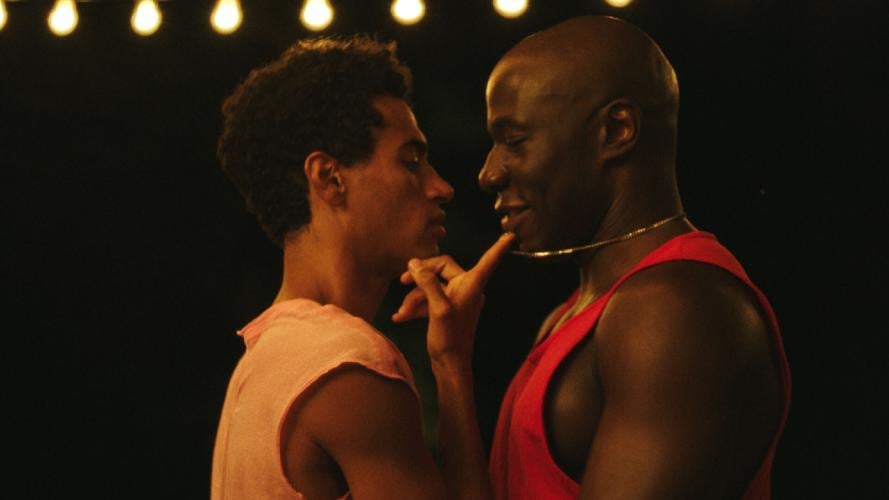
Jasai Chase-Owens (Uncoupled and The Expanse) also co-stars as Zaki, a fellow dancer. He wasn't in Olivia's dance company. Zaki is part of another dance company or he's a freelancer. The point is that he's never met Olivia or Seb before. He's new to both. He's part of this narrative because he's the new boyfriend or partner for Matty. Matty met and started dating Zaki two years ago. We don't get too much about how they met or what the dynamic is. There are implied things. Zaki is younger but it's not sure by how much. It's also implied that Zaki knows nothing about the relationship between Matty and Seb or what happened that broke them up. Given that missing piece and given the tension of this film are largely due to the breakup of Matty and Seb and the subsequent union of Olivia and Seb, one would think that this film would eventually explore or explain what exactly what went down eight years ago. It didn't need to be a flashback, but through dialogue that could have been explored or explained. Unfortunately, Brown never does so here.

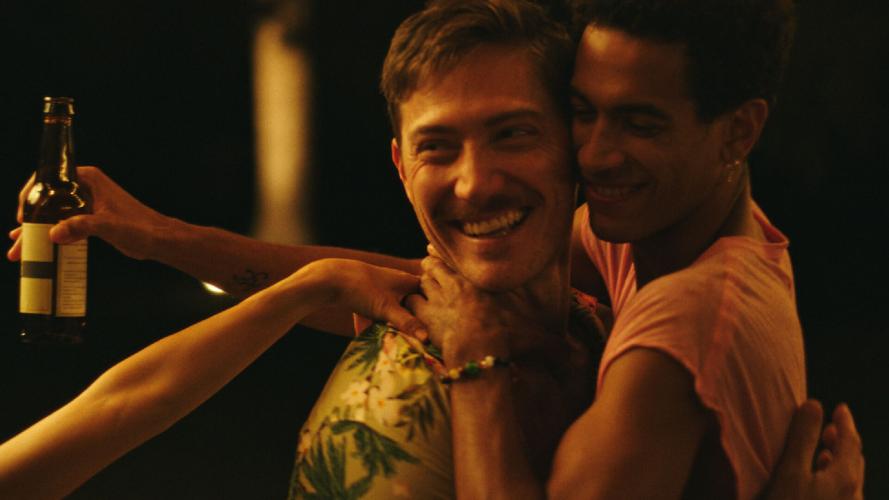
The website Bi.org has noted that this film is great in terms of its representation of bisexuality or sexual fluidity. Mainly, it's centered around the character of Seb. He was involved with a man, that of Mateo or Matty. He then went on to basically marry a woman, that of Olivia. However, it's shown that Seb is still attracted to both sexes or genders equally. Specifically, we see Seb looking lustfully or even engaging with Zaki physically. No one in this film makes this an issue. Seb's bisexuality is treated as normal and not the source of the problem or anything to criticize or even upon which to comment. This is beautiful and incredible in its own way that is separate from my criticism of this feature.
While his bisexuality shouldn't be questioned in any way, shape or form, and it's perfectly fine for him to go from being with a man to being with a woman, or vice-versa, what is lacking here is not the what but the why. Again, it's fine for him to go from being with Matty to being with Olivia, but, for the film not to explore and explain why he did so makes this film feel incredibly hollow. This film is a remake of La Piscine but there's an aspect of that film involving a death and possible murder. This film doesn't have that aspect, so this film is far shorter than La Piscine or A Bigger Splash, which is over two hours. This film had time to explore or explain what went down that caused Seb to dump Matty for Olivia.

One could possibly dismiss what went down eight years ago, but, again, Seb is also implied to have engaged physically and sexually with Zaki, and the question is why. Seb seems happy with Olivia and very much attracted to her. Is that not true? Do they have an open marriage? Is he missing sex with a man in particular? This film provides absolutely no insight into Seb's thinking or his feelings. Matty of all people deserves some kind of explanation, but this film never gives it. If the resolution was going to be not addressing the core issue that broke up this group of friends, then I fail to grasp the point of it all. Clearly, Brown wanted to end this film in a place of forgiveness, but how can there be forgiveness without understanding?
One can accept something without necessarily understanding it. That's what faith is, but this film doesn't seem to be grappling with any sense of faith or even spirituality. This film is very much a sensual one. Sensuality is Brown's chief modus operandi here, specifically when it comes to physical touch and visual sight. There are so many close-ups of people's bodies purposefully. There's an extreme tactile quality here, touching something solid. It's not about ephemeral things, so to leave the why of what Seb did as an ephemeral things feels unsatisfying. Yet, it is beautifully acted and beautifully photographed.

Rated TV-MA.
Running Time: 1 hr. and 25 mins.
Available on Here TV and Tubi.