
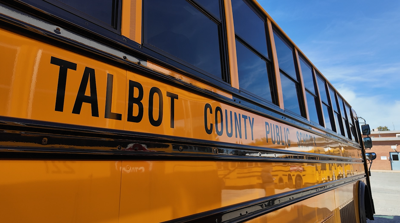


EASTON, Md. — Talbot County Public Schools is about 12 bus drivers short, and the gap is delaying pick ups and drop-offs, as well as stretching ride times for some students.
Kevin Shafer, the district’s director of operations, said Talbot has 32 drivers, full and part time combined, and is budgeted for 44.
Shafer said the district has had to consolidate routes or double up buses on a little under half of the school days this year. He added that the shortage is worse than it was a few years ago. In the 2021-22 school year the district was short on substitute drivers but not enough to affect routes.
Consolidating means combining two nearby routes so all the students ride one bus. A double run means a bus completes one route, returns to the school and then runs a second route with the same bus. Shafer said that in the morning, students sometimes arrive at school later than normal, and in the afternoon, they get home later.
The district sends parents notices, usually in the morning, when routes change. Shafer said the district is working to formalize its communication so parents can make other plans.
“We're doing our best to work towards, you know, making the routes as efficient as we can in order to minimize the delays for parents...the real consequences are the families are going to have to adjust their schedules in order to accommodate the bus route changes,” Shafer said.
Long rides, especially in St. Michaels
Shafer said one in four bus routes now runs longer than an hour, above the district’s internal goal of 60 minutes or less.
The longest rides are in the St. Michaels area, where waterfront properties and narrow necks of land already make routes longer. Shafer said some routes there now run up to 80 minutes each way. He said consolidation has made those rides longer than in previous years.
The shortage has also affected athletics. Because the county has only two high schools, Shafer said teams in a similar sport sometimes have to travel together.
A national problem with local causes
Shafer said the country has about 10% fewer bus drivers than it did in 2020. However, he said there are specific issues facing Talbot County Public Schools.
He said Talbot competes with neighboring counties for the same pool of drivers with commercial driver’s licenses.
“What we are hearing from drivers who are leaving, which we have lost, a handful of drivers this year, and it is due to, you know, some of those costs of travel and also, competitive rates across the counties,” Shafer said.
Talbot’s starting pay is about $26 an hour, which Shafer said is comparable to nearby counties that employ their own drivers.
However, Talbot is one of only four counties in Maryland where the school districts employ their own drivers and own all their own buses. Shafer said neighboring counties use private contractors, which he said get paid more, making it harder for Talbot to recruit.
Shafer said there are certain benefits for drivers working for counties like Talbot. County drivers also receive benefits, including participation in the state retirement system, that private contractors do not offer. He said that affects the hourly rate.
What the district is considering
Shafer said the district is looking at hiring a contractor for at least one route and bringing back a driver incentive program. He said this has to be negotiated due to the school’s budget.
The district also runs a paid in-house training program for people who want a commercial driver’s license, otherwise known as a CDL, and a school bus endorsement. Shafer said the district continues to recruit and will keep advocating for higher pay for drivers and aides.
If staffing improves, Shafer said, the district would split consolidated routes back out, starting with the heaviest ones. That includes long routes in St. Michaels and elementary routes in the eastern part of the county that are nearing bus capacity.
The district is also in the second year of an opt-in, opt-out process in which families tell the district each year whether they will use the bus. Shafer said it helps the district build more efficient routes, though the driver shortage still squeezes the system.
School Board President Emily Jackson addressed the issue in a Facebook post:
The bus driver shortage is a nationwide problem, and school districts across the country are struggling to recruit and retain qualified drivers. But knowing that other districts are experiencing the same challenges doesn't make it any less frustrating when it's your child's bus that is late, routes are changed, or you're scrambling to figure out how to make a last-minute change to your schedule.
**So, how do we address it?**
First, we have to focus on recruitment. We need to make driving a school bus an attractive employment opportunity, with competitive pay, benefits, and a recruitment process that makes it easier for qualified people to get behind the wheel. As you can hear from the meeting, the district continues to look for different places and ways to recruit drivers, but pay remains an important lever that can be pulled.
Second, we need to retain the drivers we have. These are people who take on an enormous responsibility every single day, transporting our children safely to and from school. We need to listen to them, understand the challenges they face, and make sure we're doing everything we can to support them.
Third, we need to make sure our drivers have the support they need on their buses. We're already working to optimize our routes as much as possible. But route efficiency alone won't solve a driver shortage. We need to be having meaningful conversations with our bus drivers about what would make their jobs more manageable, what challenges they're experiencing, and what additional support they need to be successful.
And here's where **our community and our County Council have an important role to play.** Competitive driver compensation and additional support on our buses both require funding. If we want reliable transportation for our students, we have to be willing to invest in the people who make it possible. That means having a community and a County Council committed to funding competitive driver pay and the supports our drivers tell us they need.
Finally, **communication matters.** When transportation problems happen, parents need timely, accurate information **like the messages sent home today** so they can make arrangements for their families. We may not be able to prevent every delay, but we can absolutely work to make the experience less disruptive.
I know how frustrating this is. I'm a parent with children in our schools, too. My child's bus has arrived home far, far later than it should have. And I know that for many families, reliable school transportation isn't simply a convenience. It's essential.
There isn't a single, easy solution to a nationwide driver shortage. But that doesn't mean we accept the status quo. It means we keep working on the things we *can* control, listening to the people doing the work, and making the investments necessary to improve.
**Our families deserve reliable transportation, our drivers deserve our support, and our students deserve to get to school safely and on time.**