

LEWES, Del. — The local chapter of the Daughters of the American Revolution is digging for clues about who lived on the grounds of the Maull House, one of the city’s oldest homes, and what they left behind.
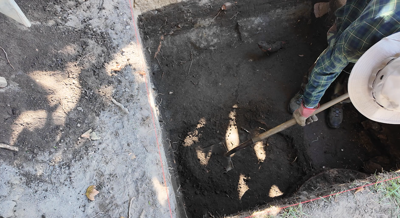
Since Friday, archaeologists and volunteers have been excavating in the backyard of the house, which the chapter owns. They have already found Native American artifacts and pieces that date to the 1700s.
The Maull House was built in 1739 for shipbuilders and river boat pilots, mariners who guided commercial ships safely through the Delaware River and Bay. The chapter wanted to learn more about their history and the people who came before them.
“I’m excited that we didn’t just find an old sneaker, we actually found some artifacts,” said Beth Bowersock, chapter regent. “...I’m excited to have found an arrowhead, an Indian arrowhead. And for me, that kind of gives proof that there were Native Americans on this property.”
How the dig began
Bowersock said the house sits near the Lewes inlet and has a freshwater well that she said is one of only seven along the canal. That raised questions about where Lewes’ earliest settlers came from and where they landed. Ground-penetrating radar done in May found pockets of items worth a closer look, and the chapter decided to dig.
Dr. Edward Otter, a private archaeologist who supervised the dig, runs a consulting firm that works in seven states and has done much of its work in Sussex County over the last 20 years.
Dr. Otter, who has been mapping Lewes, first approached the chapter about the site because of the age of the house, Bowersock said.
Otter said the radar flagged an area where the soil appeared disturbed, which is why the team dug there. Radar shows where the soil differs from how it naturally layers, which means something was dug up or buried.
“All of the things that people did that’s not written down, the only way you can learn about it is with archeology,” Dr. Otter said. “The materials it left in the ground, their food remains. All the things they were doing. The tools they had. You don't know until you find it in the ground. If it's not written down. This is the only other way to do it.”
Otter said the team had dug only three holes by the final day, so the full picture is limited. He said people may have lived on the land for thousands of years.
What they found
The team recovered about a couple dozen Native American pieces from one excavation unit, Otter said. He said the arrowhead dates to somewhere between 1000 A.D. and the arrival of Europeans, and that Dutch settlers in the 1630s recognized the area as an Indian village.
The team also found a piece of German stoneware that Otter said dates to the 18th century or possibly the 17th, and could go back to the earliest part of the house. Crews also found glass, a piece of Chinese porcelain, a few buttons and a couple of doll parts, according to Otter.
Bowersock said the finds, including china and teacups, could say something about the women of the house, who are often missing from the records.
“A pilot job was actually pretty lucrative and some of the pieces found were a little fancy,” Bowersock said.
Otter said the biggest surprise was not an artifact. One unit turned out to be a hole about 3 feet deep filled with soil and debris that someone else had put there, including broken glass and rusty nails from the 19th century. He said it is not clear why someone dug and filled it.
Volunteers do much of the work
About 30 volunteers have helped over the past few days, Otter said. They screen the soil through quarter-inch mesh so small items are not missed.
Pat Novak, a volunteer with the DAR, was among them.
“I thought it would be a fun thing to do,” Novak said. “Always thought that being an archeologist for a day might be exciting. So now I’ve fulfilled that bucket list item.”
Bowersock said the chapter has about 200 members, and only a couple had ever done archaeology before.
What happens next
The team will clean and catalog the finds, with volunteers helping on less technical tasks, Otter said. Otter said he expects the archaeological report to be completed within the next year.
The artifacts belong to the DAR, and the chapter plans to put the findings on display at the Maull House after the report is done. Bowersock said the chapter wants to tell the Native American story, pair reproductions with the pieces found, and add information to a kiosk it bought.
Bowersock said the chapter bought the house in the 1950s but could not pay for it until 1961, to keep it from being torn down. The dig, including the radar survey, cost about $6,000, paid through a donation, a fundraiser and member contributions.