

DOVER, Del. - Delaware is creating a new commission aimed at giving Indigenous communities a formal voice in state government.
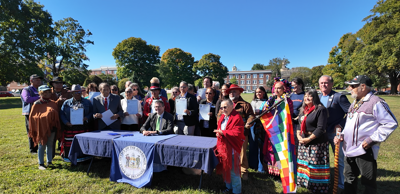
Gov. Matt Meyer joined lawmakers and tribal leaders Wednesday for the ceremonial signing of legislation establishing the Delaware Commission on Indigenous Affairs.
House Bill 365 creates a nine-member commission within the Department of State. Members will include representatives of the Lenape and Nanticoke Tribes, along with other Indigenous Delawareans.
Meyer said the commission represents an opportunity to recognize Indigenous communities and their connection to Delaware's land.
"I express excitement for a future, a bright future for our state," Meyer said. "A state that will preserve the beautiful lands that indigenous communities have spent thousands of years preserving, and will celebrate the cultures that, for too often on these lands, has not been celebrated the way they should."
House Majority Leader Kerri Evelyn Harris, one of the bill’s sponsors, said the legislation carries particular significance for tribal members who pushed for greater representation.
"They felt you," Harris said, recalling the emotional reaction during the House vote. "I think it struck our legislative, for the first time, what this really meant."
Harris said the commission is about more than creating another state board.
"This isn't just another commission. But this is the commission that we've forgotten," she said. "It should have been the first commission for the first people."
The nine-member commission will provide recommendations and information to state leaders and report annually to the governor and General Assembly.
For tribal leaders, the creation of the commission means having a direct place in conversations about issues affecting Indigenous communities.
"We're glad to represent all the people that are living here in Delaware," said Doris Cooper, a Lenape Tribe elder. "But most of all, we're glad to have a seat at the table."
Cooper said that seat could help ensure Indigenous perspectives are included in discussions about education, history and Indigenous rights.
"Our history wasn't told by us. It was what we told to someone else, and it was told by their perspective," Cooper said. "So now with us being at the table, we're hoping that we can actually get our stories written down ... in our voices."
Cooper said the commission has been years in the making.
"It's been a long time coming. We've been fighting for it for years," she said.
Sen. Trey Paradee, D-Del., another sponsor of the legislation, said one priority will be ensuring Delaware students learn an accurate history of Native Americans.
"It's important that the true history of Native Americans, not just Delaware Native Americans, the Lenape, the Nanticoke, but all Native American history be taught accurately to Delaware schoolchildren," Paradee said.
He said preserving Indigenous heritage and making sure it is accurately represented will be part of the commission's work.
Dr. Bonnie Hall, historian for the Nanticoke Indian Tribe, said the commission also creates an opportunity to address how Indigenous history is taught in Delaware schools.
"I find it ironic to have two state-recognized tribes in the state of Delaware, and the curriculum for our educational system doesn't include anything specific to those tribes," Hall said.
Hall said she hopes the commission will open conversations with educators and state education officials about incorporating Indigenous voices into the curriculum.
She also described Wednesday's signing as more than a legislative milestone.
"This is not only a historical milestone. This is a celebration," Hall said. "This is a celebration of the first people, the first state recognizing that indigenous people were the first persons to walk these lands and to be stewards of this land."
The ceremonial signing included a land acknowledgment, remarks from tribal leaders and lawmakers, and a presentation of Native American gifts.
The commission is expected to provide a platform for Indigenous communities to raise concerns and offer input on issues that affect their communities as it begins its work.