


Dover, Del. - Across Delaware, families who rely on in-home care for aging loved ones, children with complex medical needs and people with disabilities are feeling the strain of a growing caregiver shortage.
For Haley Shiber, private duty nurses are more than healthcare workers — they are the reason she can live independently.
"My private duty nurses are my lifeline," Shiber said Thursday at Legislative Hall in Dover.
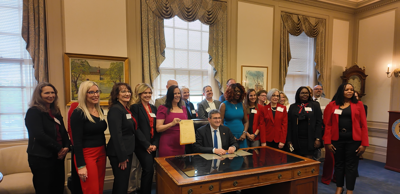
The Smyrna resident joined caregivers, healthcare providers and lawmakers for Delaware Home Care Advocacy Day, where advocates pushed for increased Medicaid reimbursement rates for in-home nursing and personal care services.
Supporters say Delaware is facing a growing shortage of home care nurses and aides, driven largely by low wages and difficulties recruiting and retaining workers.
Without skilled home care, Shiber said her daily life would look dramatically different.
"Without skilled private duty nurses, I would not be able to live in my home, work, participate in my community, or maintain my health, safety and independence," she said.
One of those caregivers is her sister, Hope Shiber, who left hospital nursing nearly a decade ago to care for Haley full time at home.
"I just loved it so much and feel very, very blessed to be afforded the opportunity to be in this position," Hope Shiber said.
But she said transitioning from hospital nursing to home care also came with a financial sacrifice.
"Transitioning from a hospital salary to a homecare salary was a difference," she said.
Advocates say that pay disparity is contributing to workforce shortages across the state as home care agencies compete with hospitals, nursing facilities and even retail employers for workers.
Sue Getman, executive director of the Delaware Association for Home & Community Care, said increasing Medicaid reimbursement rates would allow agencies to offer higher wages and better retain caregivers.
"We'll be talking to legislators about the importance of increasing Medicaid reimbursement rates so that we can offer a higher wage that will allow us to recruit and retain both private duty nurses and personal care workers," Getman said.
Getman said home care can also be more cost-effective for the state than hospital or long-term care stays.
"The cost in the state through Medicaid for hospital care, for skilled nursing facilities is much higher on a daily rate," she said. "But we're competing with them because of the salary differential."
Advocates say home care allows many vulnerable Delawareans — including seniors, people recovering from surgery and children with complex medical needs — to remain safely in their homes and communities.
Providers also highlighted other workforce barriers, including repeated background checks for caregivers working multiple jobs.
On Thursday, Gov. Matt Meyer signed legislation creating a one-year retention period for caregiver background checks, allowing records to be reused rather than requiring repeated screenings with different employers.
State Sen. Kyra Hoffner, D-Del., said many home health aides work multiple jobs to support themselves.
"Our home health aides usually have to work two or three jobs," Hoffner said.
Advocates say they hope the legislation, combined with higher reimbursement rates, will help stabilize Delaware’s home care workforce before more families lose access to in-home services.
For Haley Shiber, the issue is deeply personal.
"You are supporting people like me," she said. "You are investing in me. My safety, my independence, my ability to live my best life in my home and my community."