


DELAWARE - Delaware officials are pushing a new package of healthcare legislation they say could make hospital care more affordable and easier to navigate for families struggling with rising medical costs.
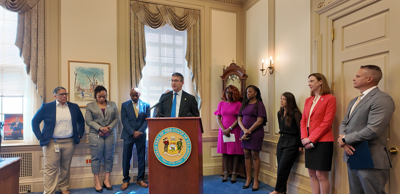
Gov. Matt Meyer joined lawmakers, healthcare leaders and state officials in Dover Tuesday to announce Senate Bills 13 and 313 — two proposals focused on expanding charity care, limiting for-profit hospital control and shifting the state toward new healthcare payment models.
The announcement comes as Delaware leaders warn healthcare costs continue climbing for working families and seniors across the state.
"Delaware families across our state are doing everything right. They work hard, they pay their bills and they put food on the table. Yet their cost of living is rising," Meyer said.
Meyer said many Delawareans are delaying care because they fear the financial impact.
"No one should skip a doctor's appointment because they're afraid of their co-pay and the bills that await them," Meyer said. "No one should end up in an emergency room because they couldn't afford to go to a routine checkup. Health care costs are high and they're rising faster than ever."
Expanding charity care access
Senate Bill 13 would expand and standardize charity care policies at Delaware hospitals.
Under the proposal, anyone making less than 300% of the federal poverty level could qualify for free hospital care regardless of insurance status.
Officials say the goal is to simplify a system they describe as confusing and inconsistent from hospital to hospital.
"We're simplifying it so that there's standardization across our state," Meyer said. "So if you go to any acute care hospital in our state, you'll know here's the charity care rules and here's what you're entitled to."
Meyer said the proposal grew partly out of Delaware’s efforts to forgive medical debt.
"In the course of forgiving medical debt, it became clear that a lot of the folks we were helping out shouldn't have accumulated that debt in the first place," Meyer said. "They should have qualified under existing hospital charity care policies."
He added that many patients who already qualify for assistance are unaware the programs exist.
"So there's a gap there that people entitled to lower cost care are not getting access to it because they're not aware," Meyer said.
The Delaware Healthcare Association says hospitals support improving access to financial assistance, but also want to ensure the changes are realistic for healthcare systems already under strain.
"We were really just trying to make sure that whatever was going to be in the bill was something that we could operationalize and wouldn't have a huge financial burden on our hospitals because we were already facing so much and being asked to do more with less," said Christina Crooks Bryan with the Delaware Healthcare Association.
Bryan said hospitals worked closely with lawmakers to balance patient access with implementation concerns.
"Making sure that we're still carrying out the intent of legislation, still ensuring that people will have greater access to financial assistance, but also making sure that our hospitals are able to implement it on the back end," Bryan said.
Limiting private equity involvement
Senate Bill 313 would place a two-year moratorium on for-profit entities gaining control of Delaware health systems.
While Delaware currently has no acute care hospitals owned by private equity firms, Meyer said state leaders want safeguards in place before ownership models change.
"There are no acute care hospitals that are owned by private equity," Meyer said. "However, there are plenty of examples around the country of private equity taking over hospitals."
Meyer argued healthcare should remain centered on patients rather than investors.
"People look at our health care industry as they do in Delaware and around the country, around the world as a business and investment opportunity," Meyer said. "While most Delawareans look at health care as a basic human necessity and human need to live everyday life."
He also warned about the potential consequences of private equity ownership.
"Private equity acquires what is critical to the public, puts debt on it, bleeds it dry, cuts resources, and then our hospitals and communities suffer," Meyer said.
Push toward value-based care
State officials also announced efforts to expand multi-payer value-based healthcare models in partnership with the Delaware Department of Insurance.
The model shifts away from traditional fee-for-service healthcare, where providers are paid for each service performed, and instead focuses on overall patient outcomes and efficiency.
Secretary of Health and Social Services Christen Linke Young said the current system rewards volume instead of value.
"We all want good health outcomes at low prices," Young said. "But the fragmented health care system mostly creates incentives to bill for more care, not to drive efficiencies and lower costs."
Young compared the current system to paying a mechanic for every bolt tightened instead of paying for a car that runs properly.
Insurance Commissioner Trinidad Navarro said healthcare prices continue driving insurance premiums higher across the state.
"With health care prices actually driving up our insurance premiums, we aim to fix that," Navarro said. "The diagnosis is clear and the treatment is under way."
Bryan said collaboration across the healthcare industry will be necessary to improve affordability.
"We need the entire health care system to come together on ways to really make health care more affordable for Delawareans," she said.