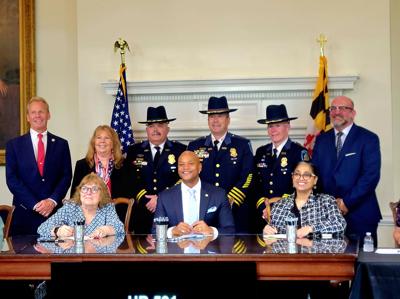

WICOMICO CO., Md. - Maryland Governor Wes Moore has signed the Wicomico Highway Pedestrian Safety Act into law, a local public safety measure aimed at restricting pedestrians from standing in dangerous areas along roadways in Wicomico County.
House Bill 591, sponsored by Delegate Barry Beauchamp, and its Senate crossfile, Senate Bill 367, sponsored by Senator Mary Beth Carozza, prohibit people from standing in roadways, shoulders, median divides or intersections that Wicomico County or local municipalities determine to be inherently dangerous.
The bill was signed Tuesday during a ceremony attended by Salisbury Police Chief David Meienschein, along with Captains John Felts and Ryan Koerner.
Under the new law, local governments in Wicomico County will have the authority to designate specific roadway areas where pedestrian activity is prohibited due to safety concerns. Supporters of the legislation have argued the bill is necessary to reduce risks to both pedestrians and drivers at busy intersections and heavily traveled roads throughout the county.
“An individual who stands in a roadway poses various challenges and risks to themselves, the drivers on the road, the responding officers and the surrounding community,” Senator Carozza said in a statement. “This legislation allows our public safety officers to protect the public and assist those individuals who may need assistance due to poverty and homelessness.”
The measure received support from several local agencies and organizations, including the Wicomico County Sheriff’s Office, Wicomico Public Schools, the City of Salisbury, Salisbury University, the Wicomico County Council, Wicomico County Executive Julie Giordano and the Wicomico County State’s Attorney’s Office.
The proposal previously sparked debate in Wicomico County during this year’s legislative session, with some residents and advocates questioning whether the law could disproportionately affect people experiencing homelessness or those soliciting donations near intersections.
Supporters, including local law enforcement leaders, maintained the legislation is focused solely on pedestrian and traffic safety rather than criminalizing homelessness or poverty.
The law is now slated to take effect later this year.