
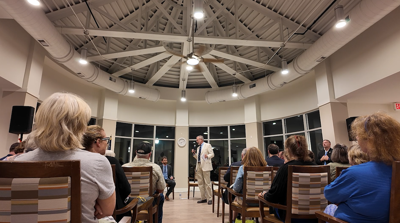

CAMBRIDGE, Md. – Republican U.S. Rep. Andy Harris and Democratic challenger Dan Schwartz faced off Tuesday night in front of a packed house in Cambridge, in what could be their only face-to-face meeting before the November election.
The League of Women Voters hosted the forum and moderated the debate. Audience members also submitted their own questions.
Harris, the incumbent, pointed to his experience in Congress and the federal money he has brought to Maryland’s 1st Congressional District. Schwartz said Harris is too closely tied to President Donald Trump. He also argued that federal policies are driving up costs on the Eastern Shore.
Immigration
The candidates discussed immigration and its effect on the poultry and seafood industries, which rely heavily on immigrant workers.
Harris said the country has to fix its temporary worker system, discussing his leadership on the H-2B and H2-A system.
“We have workers to work our temporary industries like, seafood processing, like the tourism industry, and make temporary, the temporary protected status,” Harris said. “Look, we're we're a very caring nation, but it's temporary. The earthquake in Haiti was decades ago. We have to go back to a system that’s sustainable.”
Schwartz said many Haitians on the Shore are living in fear.
“We have members of our Haitian community who are literally hiding in their homes right now,” Schwartz said. “They can not come out for fear of being ripped out of our communities. These are not illegal immigrants. These are people here under temporary protected status, like the congressman said. To prove the temporary protected status should no longer be in place, the government has to prove that the conditions in that country have changed for the better.
Health care
The moderator noted that the district has a large rural and older population that depends on Medicare, and that Eastern Shore hospitals face physician shortages. Congress created a $50 billion rural health program, and Maryland’s five-year award is $168.2 million. The moderator asked how each candidate would make sure that money reaches the Shore, and whether they would support further federal Medicare payment cuts to hospitals and physicians.
Schwartz said Cecil County recently became the only maternity care desert in Maryland after ChristianaCare Union Hospital closed its labor and delivery unit in June. He said the county lost its last OB provider about a week ago. He noted that Harris is an obstetric anesthesiologist who knows how much time matters in high-risk pregnancies, and said a 45- to 75-minute drive to get care is unacceptable.
Schwartz acknowledged the $50 billion for rural hospitals, but said Congress cut $137 billion from rural health care at the same time.
“You’re left with an $87 billion cut. And our hospitals are closing,” Schwartz said.
Harris said every Democrat in Maryland’s congressional delegation voted against the rural health fund, and that Schwartz has said he would have opposed the bill. He said Congress cut waste, fraud and abuse from Medicaid, including adding work requirements for able-bodied adults without children or dependents.
“You should not depend on your neighbor who’s a hard earned taxpayer to pay that,” Harris said.
Farm policy
On agriculture, Harris said the House passed a farm bill in April, but that most of its provisions, including crop insurance, were included in the reconciliation bill because he expected a standoff over work requirements for SNAP, the federal food assistance program. He said a second part of the farm bill remains stalled over how much states should be held accountable for errors in SNAP payments.
“We put all the important parts for the farmers in the reconciliation bill,” Harris said. “Now, remember, that's the reconciliation bill that my opponent said he wouldn't have voted for.”
Schwartz said Congress has taken too much time off and that farmers are struggling. He described a farmer neighbor in rural Cecil County who voted for Harris and Trump, but who is now facing higher fertilizer and repair costs.
Schwartz says tariffs are hurting farmers.
“It is the tariffs that are crippling our farmers,” Schwartz said. “We close down their access to their main international buyer in China, and we've made it so hard for these guys… We got to put the people at NOAA back to work who monitor weather. We have to restore our crop cover program.”
Diesel prices and U.S.-Russia relations
Diesel prices were also a contentious topic. Prices topped $6 a gallon for the first time in September, and the discussion tied into U.S. relations with Russia.
Harris said he supports export limits to make sure the U.S. can produce diesel at home. He blamed Democratic environmental policies for the lack of new refineries.
“Democrat environmental policies have not allowed us to build refineries in the United States,” Harris said. “Regardless, we still will find 5 million barrels of diesel a day. We only consume three 3 million barrels a day. That's why I called for export limits, to make sure that we keep our diesel produced domestically in this country, where it can be sold at a lower price.
Schwartz took aim at the idea of easing sanctions on Russian diesel.
“Making a deal with Russia to lift sanctions on their diesel when they are actively working with Iranian forces to kill our troops is not only wrong, it’s disgusting,” he said. “And it follows a pattern of this administration. Pardoning criminals, pardoning people and foreigners who are breaking laws in our country.”
Solar panels and farnmland
On protecting farmland from solar development, Schwartz said the region needs to be deliberate.
“We do need solar. We don’t need it on our farm fields. We need it on our homes, on our big box stores,” he said.
Harris said he has the support of many farmers on the Shore.
“I’m watching their backs against the radical Democrat environmentalists who want to remove every single farm from the shore and replace it with solar panels,” he said.
Flooding
On flooding, Harris, who lives in Cambridge, said most of Dorchester County sits within a few feet of sea level. He said building codes and flood insurance programs need to be kept up to date. He criticized the federal government for rebuilding flooded homes in the same place, citing Port Deposit in Cecil County, and said he wants to change the flood insurance program so repeatedly flooded properties are bought out.
Harris also said hard shoreline protection is usually the better approach, and that the federal government spends two to four times as much on “soft” shoreline projects that protect less.
“The best way to do shoreline in most places is hard shoreline,” he said.
Schwartz said the district includes some of the country’s first climate refugees, including people from Smith Island and other islands in the Bay. He said Crisfield’s elementary school regularly becomes an island during floods, and that the “Big Beautiful Bill” targeted FEMA grants, including $36 million that would have helped the city with flood remediation. He said a federal judge ruled that the executive branch cannot withhold money Congress appropriated.
Schwartz also said that every dollar spent on flood remediation saves $6 in disaster recovery.
“Mother Nature does not care if you’re a Democrat or Republican,” he said. “A flood could come for any of us and our citizens. Our neighbors in Chris Field deserve to have a federal government that will be helpful and not make their lives harder.”
Data centers
Data centers came up during the forum. After the debate, WBOC asked each candidate to expand on the issue.
Schwartz said he wants local and county officials to have a say over data center development in their areas.
“I’m going to ensure that states like Maryland have the ability to regulate these companies,” he said. The big beautiful bill attempted to take that right away. And we have to work together with other states, and we have to work together as a federal government and with other countries to make sure we're collaborating to hold.”
Harris said local governments should have authority, but that the federal government should set some ground rules.
“I believe that local jurisdictions have the authority the federal government should have, but the federal government should put guardrails on data centers,” Harris said. He said those rules should require the latest technology that doesn’t involve extensive use of local water resources. What they should say is that they have to use the latest technology that doesn't involve extensive use of local water resources. And they should, we should, make it so that data centers have to bring their own energy.”
The health of the Chesapeake and watermen
Harris stressed his work to expand catfish processing facilities, including setting up a USDA program to give grants up to $1 million to build blue catfish facilities.
“The control of blue catfish is credibly important to saving the Chesapeake Bay because they eat everything,” Harris said. “So what you got to do, because we have arcane rules about inspecting them, is you have to build dedicated processing facilities.”
Harris also said federal tax dollars that pay for oyster sanctuaries should come with a deadline: if a sanctuary isn’t meeting its goals after a set number of years, watermen should be allowed to harvest there on a limited basis.
Schwartz backed giving watermen a bigger voice in environmental policy and said enforcement should target more large commercial operations rather than small watermen.
He said watermen near his home in Bellevue sometimes have Department of Natural Resources police flying drones over them, and that taking even one oyster from a protected sanctuary can bring five-figure fines and loss of a license.
“We have to focus on the biggest rule breakers and make sure we're empowering our local men and women who work in the dangerous work that they do, putting food on our plates.,” Schwartz said. “...These are just people trying to make a living…We should let them do that work. Instead should be going after companies like Omega Protein, which are going out there with these giant nets, and they're 3 or 4 boats and taking all of our bait fish, our menhaden.”
Other topics
The forum also included discussion of question 3, the Bay Bridge rebuild, and offshore wind.