
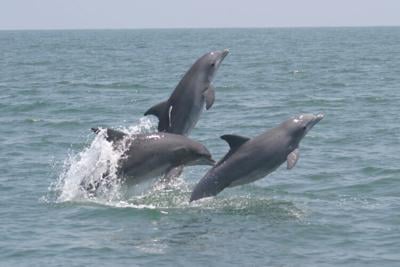

CHESAPEAKE BAY - Federal researchers believe some bottlenose dolphins spend their summers in the Chesapeake Bay, but how many swim into its waters is still a mystery after a recent count by the National Oceanic and Atmospheric Administration left the Bay out of the survey.
What the research did reveal, however, was that those visits to the Chesapeake area can sometimes prove fatal.
A new federal draft report published Friday, Nov. 20 documents 382 Tamanend's bottlenose dolphin strandings over five years, most of them in and around the Bay. NOAA Fisheries found signs of fishing gear entanglement in 31 cases and evidence of vessel strikes in three.
The findings offer a look at what happens to dolphins in some of the same waters where they spend their summers. They also highlight a gap in NOAA’s research. The aerial survey behind the agency’s estimate for the Mid-Atlantic’s coastal dolphin population did not cover waters inside the Chesapeake Bay itself.
That dolphin count is just one aspect of a much broader review. NOAA Fisheries prepares assessments under the Marine Mammal Protection Act to track the health of marine mammal populations. The 2026 draft updates assessments for populations in the Atlantic, Gulf of Mexico, Pacific, and Alaska. Along with estimating how many animals are in a population, NOAA looks at whether those numbers are growing or shrinking, how many animals are killed or seriously injured by human activity, and how those losses compare with what the population can sustain.
What the strandings revealed
The 382 strandings occurred from 2020 through 2024 across coastal and estuarine waters in Maryland, Virginia, and North Carolina according to the draft report. Researchers found evidence of human interaction in 40 cases. They found no such evidence in 51 cases and could not make a determination in the remaining 291, often because the animals were already too decomposed to examine for those signs.
Researchers look for clues such as net marks, wounds from fishing line or gear still attached to an animal. Those clues can show that a dolphin encountered fishing gear, while the cause of death can remain unknown. NOAA also says stranding records capture only part of the problem because some dolphins that die or suffer serious injuries at sea are never found.
The report takes a closer look at fisheries that overlap with dolphin habitat, including Chesapeake Bay inshore gillnets and Virginia pound nets. In some cases, researchers found dolphins entangled in commercial pound net gear. In others, they found marks consistent with the gear but had no net attached to the animal. NOAA says the records provide a minimum count and leave the overall impact of the Virginia pound net fishery uncertain.
How many dolphins spend the summer in the Bay?
Two populations of bottlenose dolphins use the Chesapeake Bay, according to researchers. One travels along the Mid-Atlantic coast while the other is associated with North Carolina’s estuaries, though photo records show some of those dolphins also move into Virginia waters and the Chesapeake. The populations overlap, and NOAA could not reliably assign the dolphins in the Bay-area stranding numbers to either group.
NOAA’s best estimate for the broader Mid-Atlantic Coastal population is about 17,200 dolphins, based on aerial surveys in 2021. Because the flights skipped waters inside the Chesapeake, NOAA says the estimate is likely low, and researchers still don’t know what share of that population spends the summer in the Bay.
Despite that likely low estimate, NOAA considers the coastal population “depleted” under the Marine Mammal Protection Act and believes it remains below its optimum sustainable level. The available surveys point to a decline between 2010–11 and 2016. The 2021 estimate showed no significant change from 2016, leaving researchers with limited evidence about whether the population is now growing or shrinking.
According to the report, The Mid-Atlantic Coastal population is still recovering from two unusually large mortality events, one in 1987 and another in 2013-2015. Both of the die-offs were attributed to a viral epidemic and included the deaths of dolphins north of Assateague, according to NOAA.
NOAA Fisheries is accepting public comments on the draft 2026 Marine Mammal Stock Assessment Report through Feb. 18, 2027.