
ISTANBUL (AP) — The Turkish energy minister has laid out plans for his country to wean itself away from coal and other fossil fuels as it prepares to host the COP31 climate change summit.
World leaders are due to arrive next week in the Mediterranean city of Antalya, and Turkey’s hosting of the annual environmental conference has thrown a spotlight on its own coal, oil and gas usage.
Turkey is Europe’s largest coal power generator, according to energy think tank Ember. The Turkish Energy Ministry says coal remained its largest source of power last year, accounting for 33% of generation. The share of solar and wind in electricity generation stood at nearly 23%.
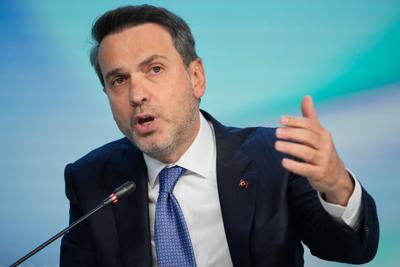
Energy Minister Alparslan Bayraktar revealed the National Energy Plan 2040 to reporters in a presentation made public Friday, in which he said Turkey would aim to transition from coal to cleaner energy sources — a process known as electrification. This would help it fulfil its pledge to reach net zero emissions by 2053.
“When we reach 2040 we are going to reduce our emissions by 40%. This big change in electrification will make this happen,” he said, adding that the use of solar and wind energy sources would more than quadruple over the next 13 years.
“Our aim is to reach 36% electrification by the year 2040,” he told a news conference in Istanbul. Using transport as an example, Bayraktar said the number of electric cars on Turkey’s roads would increase from around 500,000 to 20 million in the next 13 years.
The aim of the plan is to produce a “paradigm shift” in how energy is used in Turkey. “We have a huge project list ahead of us,” the minister added.
Huge level of investment needed
Such a shift, however, would require a huge level of investment — $500 billion in the next 13 years, some $210 billion of which would come from Turkish public sector companies with much of the rest from foreign investment.
“If the world is serious about carbon neutrality and if we would like to fund (fighting) climate change and global warming, we need to find the money,” Bayraktar said. “Everyone needs to take some responsibility and provide money for that.”
He also emphasized the importance of a transition from coal to clean energy that would not negatively impact communities reliant on mines and power stations for employment.
“We are looking for a just transition from coal to relatively cleaner sources of energy… but we need coal for security of supply,” he said.
“Equally important is that (coal mining) is providing at least 30,000 to 40,000 people with employment and labor opportunities. How are we going to make these miners into AI experts or high-tech experts? It’s not going to be easy. We need a just transition period.”
Despite aiming to break away from coal, Turkey will remain tied to other fossil fuels, particularly natural gas, for the foreseeable future.
Turkey recently started drilling gas reserves in the Black Sea and Bayraktar said production would double to 7.5 billion cubic meters annually in the coming years.
Growing nuclear power
Another key area would be nuclear power. The Akkuyu nuclear power plant on the Mediterranean coast is nearing operation and there are plans for another nuclear station by the Black Sea.
These would contribute towards the “very ambitious target” of Turkey becoming energy independent by 2040, Bayraktar said.
Turning to the “turbulent times” facing energy markets, Bayraktar described how sanctions around the wars in Ukraine and Iran were impeding efforts to fight global warming.
“We are trying to become carbon neutral in less than three decades’ time and with all these difficulties it’s very difficult to achieve this,” he said.
According to the Climate Action Tracker, which measures countries’ progress against goals of the 2015 Paris Agreement, Turkey’s climate targets and policies are “critically insufficient.”
The agreement set a target of limiting global temperature rise to 1.5 degrees Celsius (2.7 degrees Fahrenheit) compared with the early 1800s.
Looking ahead to COP31, Bayraktar said his key message would be for countries to adopt “responsive and realistic policies” to achieve carbon neutrality.