
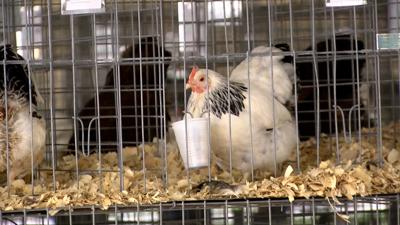

COLLEGE PARK, Md. – Researchers at the University of Maryland have received nearly $2 million in federal funding to develop and test a vaccine designed to protect chickens from avian influenza H5N1.
Andrew Broadbent, an assistant professor in the Department of Animal and Avian Sciences at the University of Maryland, College Park, and Lynda Coughlan, an associate professor at the University of Maryland School of Medicine in Baltimore, were awarded $1.99 million from the U.S. Department of Agriculture through its Animal and Plant Health Inspection Service.
The funding will support efforts to develop a vaccine aimed at helping protect poultry against H5N1, commonly known as bird flu.
The ongoing outbreak of H5N1 is widely considered one of the most significant animal health events in U.S. history, having infected more than 170 million poultry. The virus has disrupted the food supply, increased costs for farmers, and contributed to higher egg prices for consumers.
Researchers say their vaccine uses a non-replicating adenovirus as a delivery platform. Early studies funded through the MPowering the State initiative, a partnership between the University of Maryland, College Park and the University of Maryland School of Medicine, showed the approach produced strong immune responses in chickens.
Those initial results found antibodies generated by the vaccine recognized multiple H5 strains, suggesting the potential for broader protection as the virus continues to evolve. Researchers also say the vaccine remains stable at room temperature and can be modified to protect against emerging strains.
“It is in an early stage of development so we have a candidate vaccine that we have shown induces good immune responses so we are quite confident that we will be able to make a successful product,” Broadbent said. “As far as a time scale I can’t speak to that directly.”
With the new USDA funding, researchers plan to expand antigen production, refine vaccine candidates to address newly emerging H5 variants, and test different doses and methods of administering the vaccine.
While research continues, the poultry industry has historically been hesitant about bird flu vaccines because some countries do not accept vaccinated chickens in international trade.
The Delmarva Chicken Association told WBOC it agrees with the National Chicken Council that a bird flu vaccine would need strong export market protections before receiving its support.