
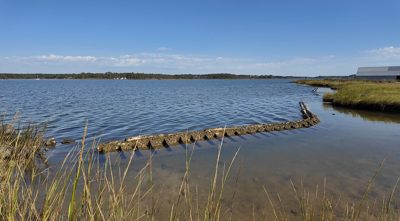

CAMBRIDGE, Md. — A new type of material for living shorelines is being tested in Dorchester County as a lower-cost way to protect Maryland’s eroding coastline while giving oysters and fish a place to live.
The QuickReef, the first of its kind in Maryland, was installed in June along a tidal marsh in Cambridge. The Eastern Shore Land Conservancy and the company Native Shorelines are piloting it on a conservation easement, with funding from a federal grant.
QuickReef is built from calcium carbonate concrete, the same chemical compound oysters secrete to form their shells. That gives oyster larvae a natural surface to settle and grow on while the structure shields the marsh behind it from waves.
Jeff Corbin of Native Shorelines, who installed the project, said the product has existed for four or five years but had not been used in Maryland waters before. He said some traditional protection methods can cause a loss of natural habitat, which QuickReef is trying to solve.
“So many of the crabs, oysters, fish for recreational fishing, for commercial fishing, need this shoreline habitat,” Corbin said. “And if you cover it up with riprap or you harden it with a wooden bulkhead, you have lost that critical habitat…We're just looking for it to become more and more thriving and organic over time,” Corbin said. “We're looking for more oysters. We're looking for more algae. We're looking for more fish around here.”
Larisa Prezioso, who managed the pilot project for the land conservancy when it was first installed, said the group is excited that the shoreline provides habitat benefits and was fast to build.
“It uses an innovative product that hasn't been used in our state waters before that we're very excited about because it offers a lot of habitat benefits,” Prezioso said. “It was super fast to build, and it was just accessible. And overall, as the name implies, quick, which was very attractive to us because we've got more than 170 miles of tidal shoreline across all of our conservation easements. And shoreline erosion is one of our landowners biggest concerns. So we've definitely been feeling an increased demand for living shoreline assistance, and this just fills the gap.”
Protecting the shoreline
The structure works as a breakwater, an offshore barrier that absorbs wave energy before it reaches the shore. Waves strike the reef while the water behind it stays calm, which helps protect the marsh from erosion.
Unlike many living shorelines built from solid rock, QuickReef has hollow spaces inside. Fish can move in and out of them.
“It’s almost like a little fish nursery in there,” said Prezioso.
Corbin said protecting the environment between the QuickReef and the marshes is foundational to this project.
“A lot of people may not realize it because we have so much water in Maryland and the other Chesapeake Bay states, but the nearshore area that marsh fringe and that, you know, two feet of water or less is so critical because it's nursery habitat for almost every recreational and commercial fishery out there. So you're trying every time you lose marsh and you lose shoreline habitat, or you harden it with rock, you're losing that, that nursery habitat,” Corbin said.
Aiming for lower costs
The conservancy says Dorchester County has more than 1,500 miles of shoreline and some of the highest rates of shoreline loss in the state. Across its conservation easements, the organization oversees more than 170 miles of tidal shoreline, and Prezioso said erosion is among landowners’ biggest concerns.
The material costs roughly the same as rock-based living shorelines, according to the conservancy, but faster installation can reduce construction costs. Prezioso said traditional living shorelines can take a long time to design and permit.
“This is by far the most affordable living shoreline we’ve ever built,” Prezioso said. She said grant funding is increasingly competitive, and the group hopes QuickReef will give more landowners the ability to afford a living shoreline.
“I think this really just opens up a door for any landowner or conservation, landowner or not, to have something that’s affordable, fast to build and offers a lot of ecological benefit,” she said.
Corbin said keeping costs down is central to the company’s goals. He also said Maryland law lists living shorelines as the preferred approach to shoreline protection.
“We’re trying to keep it as cheap as we can so that a landowner can pay for it, because if a landowner can’t afford it, we don’t have any projects,” he said. He added that demand is growing in Maryland, where state law sets living shorelines as the preference for erosion control.
What’s next
Native Shorelines has looked at installing QuickReefs at 15 other sites in Maryland, Corbin said. He said the hope is to find more funding to help landowners who own a lot of shoreline but may not have the money to protect it.
“We're hoping maybe in the future that we can get some additional funds to help those landowners, because although they've got a lot of property and you might think all these people are wealthy, I mean, there's a lot of shoreline out there,” Corbin said.
The conservancy will photograph the site each year and compare the images with photos of the shoreline dating to 2017. Prezioso said she once saw chunks of marsh sitting in the water.
“It just feels serene and peaceful now,” Prezioso said.
If the pilot works, the conservancy hopes QuickReef can become another tool for protecting shorelines across the Eastern Shore.