
SALISBURY, Md. - Public school systems across Maryland are developing policies to determine how students and educators can use artificial intelligence in classrooms while protecting academic integrity, student privacy and the role of teachers.
The work follows the passage of the Artificial Intelligence Ready Schools Act, which requires each local school system to adopt a policy aligned with guidance from the Maryland State Department of Education. Richard Kincaid, an assistant state superintendent, said districts must approve their policies by Oct. 22.
Kincaid said artificial intelligence is already affecting schools, workplaces and the broader economy, making it important for students to understand how to use the technology responsibly.
“We want to make sure that we’re highlighting critical thinking, digital literacy and creative problem solving because we know that AI, as a technology, isn’t going away,” Kincaid said.
The state is allowing districts to choose which AI tools are most appropriate for their schools. However, Kincaid said student privacy, data security and human oversight are nonnegotiable parts of the state guidance.
“Ultimately, we provide the guardrails and give them the ability to drive on whichever road they want to drive on,” Kincaid said.
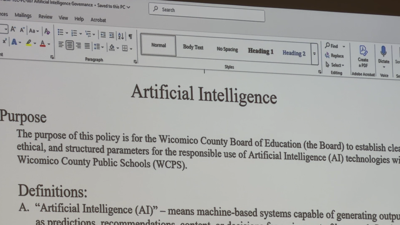
Wicomico County Public Schools is moving forward with a draft policy after the Board of Education reviewed the proposal Tuesday and reached a consensus to place it on track for formal approval.
Dr. Brian Raygor, the school system’s chief finance and operations officer, said Wicomico is not attempting to eliminate artificial intelligence from classrooms.
“We’re not looking to ban AI. We realize that would probably be impossible, but we do want to encourage its ethical use and its educational use,” Raygor said.
Under the draft policy, students who use artificial intelligence would be expected to cite it as they would any other source. The school system would also create a committee involving instructional, technology and student and family services staff to review potential AI tools and determine how they could be used.
Raygor said the committee would also help define the difference between appropriate AI assistance and academic dishonesty.
“Certainly academic integrity is something that’s always important when students are creating work,” Raygor said. “That’s going to be part of the job of that committee, finding that line and having a real clear definition.”
The draft policy is expected to be posted on the school system’s website for public review. Comments submitted on the proposal will be shared with board members before a formal vote scheduled for Aug. 11.
Worcester County Public Schools began developing its AI policy and guidance about two years ago, placing it ahead of the state requirement.
Caleb Wilson, Worcester County’s artificial intelligence coordinator, said the district’s existing guidance already addresses many of the state’s priorities, including equitable access, safety, privacy, academic integrity and human-centered decision-making.
The district also uses MagicSchool, an artificial intelligence platform that allows teachers to control when students access AI tools and review their interactions.
Wilson said students can use the technology for tasks such as creating an outline, checking grammar or receiving feedback on their writing. However, he said students should not use AI to avoid thinking deeply about their assignments.
“We want to encourage that with our students and actually teach them to leverage AI in service of rigorous thought and getting them to use it to further their education, not shortcut that process,” Wilson said.
Worcester has offered several voluntary AI training cohorts for employees and plans to begin mandatory foundational training for instructional staff this fall. Wicomico has also offered summer AI sessions for administrators and plans to expand professional development opportunities for educators.
The Maryland State Department of Education is developing foundational training for approximately 120,000 educators and school employees. Kincaid said that training is expected to be available statewide by June 30, 2027.
School leaders said policies will need to remain flexible as artificial intelligence tools and their capabilities continue to change. Worcester reviews its approved digital tools annually, while Wicomico’s proposed procedures could be updated as frequently as needed.
“AI changes, it feels like, every week,” Kincaid said.