
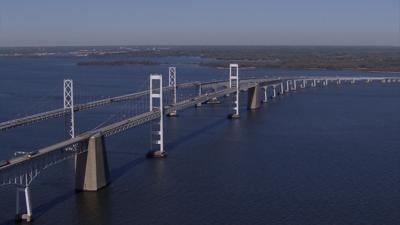

BALTIMORE - The Maryland Transportation Authority Board voted Thursday on a recommended plan to construct two new four-lane bridge spans across the Chesapeake Bay and remove the existing spans.
As WBOC previously reported, Maryland has been eyeing possible solutions to address traffic issues on the Chesapeake Bay Bridge for years, including widening the bridge spans and expanding Route 50. Now, the MDTA is pushing for a specific plan that would see the spans replaced entirely.
Queen Anne's County Commissioner At-Large Jim Moran said the development is welcomed.
"Eleven years ago, Governor Hogan started the NEPA process to replace the bridges," Moran said. "It's going to be another 10 years before we're actually driving over the bridge, God willing."
On Thursday, Dec. 18, the MDTA Board unanimously approved “Alternative C” which includes two new four-lane bridge spans, removal of the existing spans, widening US 50/301 to eight lanes (four per direction), and possibly adding a bicycle and pedestrian shared-use path.
“This recommendation is an exciting step that moves us closer to a Bay crossing that provides a smoother travel experience for those who drive over the bridge and the Marylanders who live by it,” said Maryland Department of Transportation Acting Secretary Samantha J. Biddle. “Alternative C is the option that best supports Marylanders’ current and future daily travel needs with the least environmental impact on our treasured Chesapeake Bay.”
MDTA says the two new spans would include full shoulders across the Chesapeake Bay to enhance safety, and the removal of the existing spans would address issues such as roadway deficiencies, narrow lanes, and lack of shoulders.
The new spans would also see an increased navigational clearance, according to the plan, matching that of the new Key Bridge and allowing larger ships to access the Port of Baltimore.
“Alternative C best fulfills the study’s purpose and need while considering environmental and financial responsibility,” said MDTA Executive Director Bruce Gartner. “Of the build alternatives, it is the most cost-effective, impacts the least amount of natural, socio-economic and cultural resources. It would enhance safety with full shoulders and wider lanes, bring between $17 to $23 billion into the local economy, and create 61,300 to 75,600 jobs with 76% direct employment of construction workers.
"Not only those that are closest to the bridge will benefit the most when it comes to the economic impact but, I think the corridor down Route 50 all the way to Ocean City is going to benefit because in the long run," Moran said. "It's going to produce more needs and wants along Route 50 and Ocean City, and more construction."
Now that the MDTA Board has voted to pursue Alternative C, the plan is expected undergo lengthy review by the public and government agencies, with public hearings currently slated for February 2026. Following the public comment period, state and federal agencies will then be invited to weigh in on the proposed alternative in Spring of 2026.
The MDTA says funding for the project is expected to begin after a Final Environmental Impact Statement and Record of Decision is issued, with final design starting in Spring 2028 and construction aimed to begin in Summer 2032.