


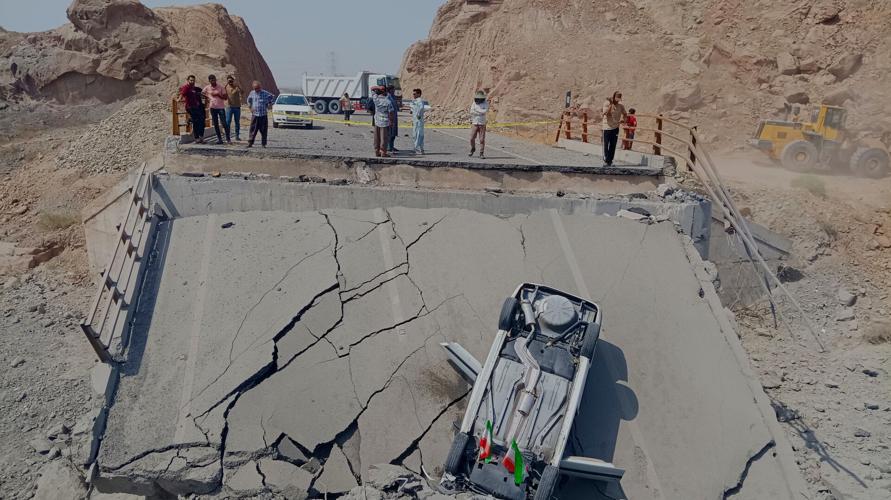
The U.S. and Iran are back to bombing every day in a bid to control the Strait of Hormuz. And neither is backing down, showing the limitations of President Donald Trump’s reliance on escalating airstrikes to bend Tehran to his will. While the Trump administration says it is open to diplomacy, Iran so far has refused to loosen its grip over the crucial oil shipping corridor in the Persian Gulf. It is raising questions about the strategy for the conflict's next phase. The intensifying attacks have collapsed an interim ceasefire deal, killed more American troops and sent U.S. gasoline prices back up, posing more problems for Republicans hoping to get reelected.
Trump warned that “every time Iran kills an American Soldier” going forward, “they will pay for that killing many times over.”
The Latest:
Appeals court rejects Biden’s bid to withhold recordings and transcripts of ghostwriter interviews
The appellate panel’s 2-1 ruling late Monday found “substantial” public interest in disclosing what former President Joe Biden wants to keep under wraps. Redactions to the recordings would help protect Biden’s privacy, the majority noted.
The judges suspended their decision until Aug. 3 to allow more time for Biden to consider another appeal.
Mark Zwonitzer, who worked with Biden on his two memoirs, interviewed the Democrat at his home in 2016 and 2017, before his presidency. Biden’s lawyers say the conversations were candid, personal and intended to remain private.
The recordings were obtained by special counsel Robert Hur, who investigated Biden’s handling of classified documents from his time as a senator from Delaware and as vice president. Republicans demanded the material after Hur declined to file charges against the then-president.
Civilian infrastructure now targeted by both the US and Iran
Both sides have targeted civilian infrastructure relied on by millions of people.
Kuwait’s Electricity, Water and Renewable Energy Ministry said Tehran struck desalination and power plants for a fourth straight day on Monday night, causing fires and damage. Some 90% of Kuwait’s drinking water comes from desalination, making the attacks a matter of life and death for the tiny nation.
U.S. strikes have been hitting electrical equipment in Iran as well, and Iranian officials also have said Americans targeted water facilities.
US command says its broad strikes are in response to Iran’s attacks on shipping
The U.S. military’s Central Command said Tuesday it targeted “Iranian military command centers, maritime capabilities, missile and drone launch sites and air defense systems.” It released more footage of bombings that targeted sites in Iran.
“American forces remain postured and prepared to hold Iran accountable for unwarranted aggression toward civilian mariners seeking to freely and openly transit the strait,” the command said.
Iranian state media reported that explosions were heard in across six different provinces.
Tanker attacks expand, forcing crew to abandon ship
Traffic through the strait has slowed to a crawl during the latest violence. Lloyd’s List Intelligence said only three ships transited the strait on Sunday.
The British military’s United Kingdom Maritime Trade Operations center said a tanker came under attack early Tuesday in the strait off Oman, forcing the crew to abandon the vessel.
Iran’s paramilitary Revolutionary Guard claimed the attack, as well as two other attacks on ships Monday in the waterway.
The route around Oman has been the one the U.S. military has encouraged ships to travel to avoid Iran’s control. The UKMTO separately reported Tuesday that another previously unknown attack on a ship took place early the previous day.
Iranian official meets mediators in Pakistan as attacks rage
An Iranian official began meetings Tuesday with mediators in Pakistan as diplomats sought to salvage the collapsed interim deal between Iran and the United States, even as both countries continued to launch attacks for a 10th day of renewed fighting.
The visit by Iran’s Interior Minister Eskandar Momeni comes as Pakistan has intensified diplomatic efforts in recent days to resuscitate the deal. However, it remains unclear just what new arrangement could be reached to end the fighting.
Momeni met Pakistan’s army chief Field Marshal Asim Munir, according to two officials who spoke on condition of anonymity to discuss the closed-door negotiations. Momeni later met Prime Minister Shehbaz Sharif. Pakistan’s political leadership and Munir, who serves as both the chief of army staff and defense forces, have worked to persuade the United States and Iran back to resume negotiations.
— By Munir Ahmed
The limits of intensifying attacks emerge as US and Iran dig in
The U.S. and Iran are back to bombing every day in a bid to control the Strait of Hormuz. And neither is backing down, showing the limitations of President Donald Trump’s reliance on escalating airstrikes to bend Tehran to his will.
While the Trump administration says it is open to diplomacy, Iran so far has refused to loosen its grip over the crucial oil shipping corridor in the Persian Gulf. It is raising questions about the strategy for the next phase of the conflict as intensifying attacks have collapsed an interim ceasefire deal, left additional American troops dead and sent U.S. gasoline prices back up — posing new problems for Republicans ahead of the midterm elections.
Even with glimmers of hope for talks, the sides could be headed back to all-out war, with Trump warning that “every time Iran kills an American Soldier” going forward, “they will pay for that killing many times over.”