
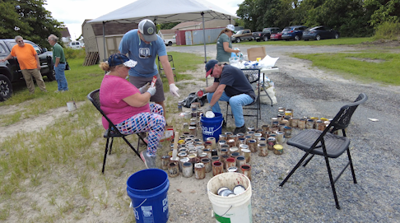

GEORGETOWN, Del. – Volunteers from Dogfish Head Brewery and the Springboard Collaborative non-profit came together on Tuesday to help prepare a site for the construction of a new pallet shelter village for homeless adults.
Tuesday’s preparations were the last of the cleanup before construction begins. Volunteers worked on two different projects; first, there were old cans of paint on the site that needed to be disposed of. Volunteers used cat litter and paint hardening materials to solidify the paint before disposing of it within the next few days. Second, they cleared fencing of overgrowth to create light and visibility in the site.
“We think it’s a really innovative approach to a problem that a lot of communities face,” says Mariah Calagione, co-founder of Dogfish Head Brewery. “Not just Georgetown, but all over. We love innovative solutions, and we’re excited to be out here seeing it come to life.”
Nora Sheehan, a Dogfish Head volunteer, had her own personal connection to the work being done on Thursday. Her son, Andrew, died from overdose while living in a homeless encampment. His thirty-third birthday would have been the day before the cleanup.
“I can’t even begin to tell you the commitment he had to the other people in the homeless community,” Sheehan says. “He just would not leave, and we tried to get him to leave. Ever since he overdosed, and actually before, I was helping at the Rehoboth Beach homeless shelter during the winter. So, this is really exciting and so important.”
Springboard Collaborative is partnering with First State Community Action Agency to bring 40 “tiny homes” to the cleared space. They’re calling the project, the Pallet Program. The homes will be small sleeping quarters with air conditioning, heat, and one or two beds. A communal restroom with showers will be built nearby, along with a community building with room for dining, a multi-purpose room, offices for Springboard staff, and a warming kitchen for meals.
“We’re going to be paying a lot of attention to outcomes,” says Judson Malone, the executive director of Springboard Collaborative. “If they come into the camp, how long are they going to stay here, and what is it going to take for them to get ready to go to permanent housing? If they have addiction, or other issues, can they at least get to the point that they are manageable and they can sustain themselves in an apartment? Do they have enough income or do they need job training to increase their income? Those are the kind of wrap around services we’re going to provide.”
Malone tells WBOC that the project is being funded by ARPA funds from the State of Delaware, donations from the Longwood Foundation, contributions from several bank CRA accounts, and donations and support resources from Healthy Communities Delaware.
“This turns out to be our first effort, but we don’t want it to be our only effort,” Malone says. “We want to do other efforts around Sussex County. We want to do other pallet villages in Kent County, and Wilmington, and New Castle County, but first, we want to prove it works.”
The village is expected to be completed by October to ensure that people in the Sussex County homeless community have housing before winter.