
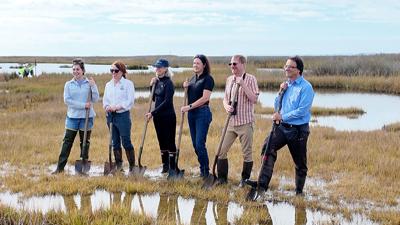

MARION STATION, Md. - The Irish Grove Sanctuary broke ground today on a restoration project as a part of the "Marshes for Tomorrow initiative" through the National Audubon Society. The project is the first marsh restoration project of a much larger initiative aimed at reversing salt marsh loss across the Chesapeake Bay and Maryland's coastal bays.
A $2.5 million investment is being provided by the U.S. Fish and Wildlife Service for the efforts in protecting habitats. Project Leader Genevieve Larouche says salt marshes provide many benefits to people and wildlife.
“I can't even overstate how important they are,” she says. “They are important for protecting houses and businesses from storm surges. I don't have the number right in front of me, but I think it's $600 million a year they'll protect the local communities from storm damages. Also very important for fisheries. This is the nursery for all the fisheries that we love, including blue crabs, menhaden, striped bass, red drum.”
Shallow channels called “runnels” began being dug on Monday, Nov. 2. Crews use hand tools to dig and restore tidal flow. David Curson, the Director of Coastal Resilience with Audubon says phase one of the project is off to a great start.
“Allowing this water to escape from the marsh basically protects the marsh by slowing down and hopefully reversing the process of the marsh being degraded by water trapped on the surface, which kills the vegetation,” he says. “Without vegetation, the high tides can scoop out and erode soil from the marsh.”
Some threats to salt marshes include rising seas, land subsidence and coastal flooding. Audubon’s Ben Graham says this project will set an example for future restoration efforts.
“Our plan is to do a lot more of these restoration projects,” he says. “They won't all be exactly like this, but some of the restoration techniques that we're testing here are things that can be exported and used at other marshes across Maryland. So we'll have more restoration projects coming online in the coming years.”
Curson says with phase one of the project complete, the hope is to have phase two begin by February or March of next year. Phase two involves crews coming back to dig more runnels where waterlogging needs to be alleviated.