
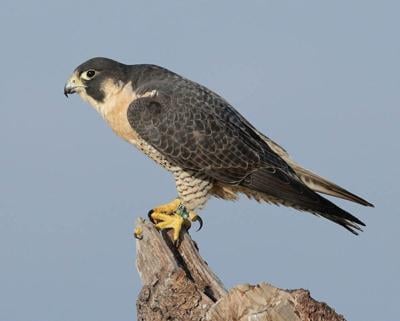

ACCOMACK COUNTY, Va. - A new study suggests highly pathogenic avian influenza, or bird flu, may be taking a significant toll on peregrine falcons that nest along Virginia's coast.
Researchers with William & Mary's Center for Conservation Biology found peregrine falcons nesting in coastal areas of Virginia and New Jersey experienced steep declines in survival and territory occupancy after bird flu arrived along the Atlantic Flyway in 2022. The study was published this year in the journal Scientific Reports.
Accomack County and Virginia's barrier islands, which host internationally important populations of migrating shorebirds every spring, are also home to a once-rebounding peregrine population. In 1981, scientists attempted to restore peregrine falcon numbers in Virginia following declines due to DDT poisoning. A breeding pair was first introduced on Wallops Island, with the first successful nesting occurring in 1982 on Assateague Island, according to the Virginia Department of Wildlife Resources.
Now, one of the world's fastest birds faces an entirely different threat here on Delmarva.
According to researchers, peregrine falcons that hunt along the coast rely heavily on shorebirds and other waterbirds for food. Those species are natural carriers of avian influenza, according to scientists, increasing the chances that falcons become infected when they capture or scavenge prey. Inland peregrines, by comparison, feed primarily on songbirds and appear to face a much lower risk of exposure.
The study tracked 205 individually marked adult peregrine falcons and monitored 79 nesting territories across Virginia and New Jersey between 2016 and 2025. Researchers found adult survival in coastal nesting areas fell dramatically after bird flu arrived. Annual survival dropped from about 82% in 2022 to just 25% by 2024. During that same period, nearly 78% of the identified coastal adults present in 2022 had disappeared by 2025.
Scientists also documented a sharp decline in occupied nesting territories along the coast.
After remaining relatively stable for years, occupancy at coastal nesting sites dropped by more than 50% between 2024 and 2025, the largest year-to-year decline observed during the decade-long study. Meanwhile, inland territories remained comparatively stable.
Researchers say the differences point to diet as the likely explanation.
On Virginia's Eastern Shore, peregrines often time their nesting season around the annual spring migration of shorebirds. During May, adults feed their young large numbers of species such as ruddy turnstones, dunlin and short-billed dowitchers, all birds known to experience avian influenza infections during migration through the region.
The study also found younger peregrine falcons are beginning to occupy breeding territories at much higher rates than before the outbreak.
Before 2022, only about 3.5% of breeding recruits were first-year birds. After bird flu arrived, that number climbed to 21%, suggesting older breeding adults are disappearing faster than they can be replaced.
The researchers note that Virginia's Eastern Shore is one of North America's most important stopover sites for migrating shorebirds, making it a critical location for understanding how bird flu moves through wild bird populations and affects predators higher up the food chain.
While several peregrine falcons in the study area have tested positive for highly pathogenic avian influenza, the researchers say continued monitoring will be necessary to determine whether coastal populations recover as bird flu activity changes in the coming years.