

EASTON, Md. — Some organizations that serve people facing hunger and homelessness in Talbot County say more residents are asking for help, even as some of the money that supports those services is shrinking.
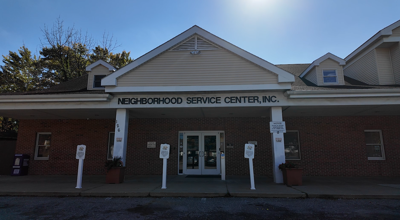
At the Neighborhood Service Center in Easton, a line forms outside the building every weekday morning for day-old bread and other products donated by local businesses. Andy Hollis, the center’s executive director, said the line is often 10 to 15 people deep, and many are mothers with children, veterans, seniors and people with disabilities.
Hollis, who has led the center for about a year, said the line surprised him when he started and that few people would notice it unless they drove past.
“...Talbot County’s prosperity hides its poverty,” Hollis said. “And what I mean by that is that and I speak from personal experience, having only been in this job a year, I didn’t realize just how severe it was for those people that are struggling, that are either in poverty, on the edge of it and things of that sort…. It's not intentional, but my job, our job here at the Neighborhood Service Center and Neighborhood Services of Talbot is to put a spotlight on it.”
The center is the county’s designated community action agency. Community action agencies are part of a federal anti-poverty effort. Each county decides what its local agency does. The center provides social services but is separate from the Department of Social Services, which Hollis said lets it go beyond federal and state regulations to help people in need.
Record demand at the food pantry
The center runs a food pantry five days a week. Hollis said it averaged about 35 people a day a year ago and recently topped 50 in a single day, the most it has seen.
“I really want people to take away that things are not status quo,” Hollis said. “Things are not stabilizing. They are growing truly more challenging for individuals by the day. And I also want to emphasize the people that come in are, as I classify it, the working poor. We have a large number of our clients that actually have jobs.”
Hollis said the pantry has shifted towards providing more fresh produce, milk, eggs and butter. It lets clients choose items from a grocery list that they fill out upon arrival. Shelves are often bare by the end of most days. He said donations are what keep food on them.
Evictions and shelter placements
Akima Copper, the center’s supportive services and outreach program director, said her team is seeing more families facing eviction. The center also placed 14 families in temporary shelter so far in October, up from nine in both August and September.
“People that come in for assistance, there’s usually something else that’s been going on with the family,” Copper said. “Housing was never the primary issue with them. Most of the time either an employment issue has happened, or there has been a medical issue in the family that led to them becoming homeless.”
Hollis said rents in Talbot are higher than in neighboring Dorchester and Caroline counties, which makes it especially hard for low-income families to find housing. Copper said there are a few low-income apartment complexes in the area, but most have become tax credit properties.
According to Copper, tax credit properties go off of what the medium income for the county is. When you are first applying to get into a tax credit apartment, the rules are extremely strict. If you make even one dollar over the area medium income, you will be denied housing.
Gaps in shelter
Talbot has the Talbot Interfaith Shelter, which is considered a “high-barrier” shelter, meaning people must meet certain requirements to get in.
In comparison, a “low-barrier” shelter accepts almost everyone, but needs to be equipped with individuals that are trained in how to deal with those specific challenges such as substance abuse, mental health and law enforcement.
Hollis said the closest “low-barrier” shelter is run by the Salvation Army in Cambridge. He said it has 25 beds, but is only open from 5 p.m. to 8 a.m., and sets aside just one section for a family. Many of the center’s clients have no transportation beyond a bicycle, Hollis said.
During extreme cold last winter, the center put people in hotels, spending more than $9,000 in February alone, he said. A Talbot County Council task force is conducting a feasibility study on the cost of opening a low-barrier shelter in the county. Hollis said he hopes it leads to a permanent shelter.
Hollis said the annual January count of homeless residents found about 52 people, but he said the number is a significant undercount because many people avoid being identified.
“It also doesn't count the number of people that are couch surfing that are moving from relative to relative on the sofa or friend to friend,” Hollis said. “This is literally people out in the field, in the area behind some of our retail stores, with a blue tarp that they're living under and things of that sort.
Funding cuts
On July 1, the center lost $142,000 in homelessness prevention funding, about half of what it received for that purpose, Hollis said. He said the money originates at the federal level. The center has reduced services but has not eliminated any.
“A 50% reduction in one fell swoop of funding a service that literally provides people the ability to not be out in the cold or the heat is too severe,” Hollis said. “There is no way that you can absorb that cut and continue to continue to provide the same level of service. So what happens to those people that were helped last fiscal year by those funds? And I am not willing to accept the argument that it’s their own fault, that they have to figure it out themselves or they can go somewhere else.”
Hollis credited the County Council for raising its support to more than $500,000, but said he plans to ask for more. The center has also raised tens of thousands of dollars since late April through a used-furniture store in downtown Easton, run by volunteers in a space donated by a local property owner.
The center also owns a 22-room communal house where residents pay between about $345 and $500 a month for a room. It is being converted into transitional housing with stays of up to 24 months.
How to help
Hollis said the center needs volunteers for its Thanksgiving and Christmas food basket giveaways and the pop-up furniture store. It also needs financial donations.
Additionally, the center is starting up its annual coat drive.
“The state of homelessness in Talbot County is significant,” Hollis said. “It is growing, it is underreported. And we are all woefully unaware of it. And we need to do more, myself especially to put a spotlight on it. And make people aware of the magnitude of it.”