

TAYLOR'S ISLAND, MD – The picturesque islands off the coast of Dorchester County are steadily vanishing because of both human activity and rising sea levels. In response, the U.S. Army Corps of Engineers has initiated a significant dredging project to salvage and rejuvenate these delicate ecosystems.
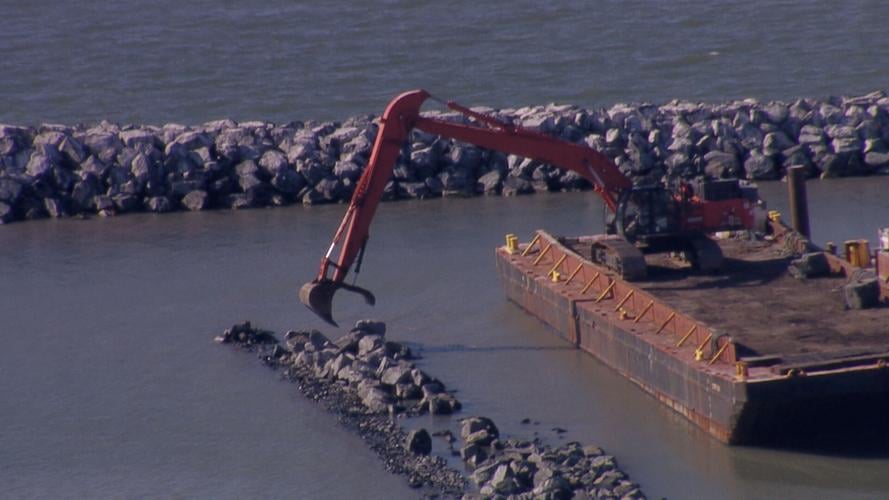
Barren Island, situated near Taylor's Island, has become a focal point for restoration efforts. According to the U.S. Army Corps of Engineers, the erosion of these remote island habitats has been accelerating over the past two decades. Since March, one can witness the ongoing efforts to reclaim Barren Island, one of the islands slated for preservation.
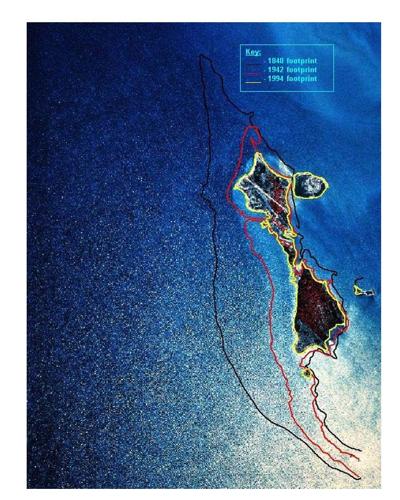
The project, currently in full swing on Barren Island, aims to restore 72 to 83 acres of wetlands. A visual representation of the island's history [pictured above], depicted through red and yellow lines on a map, reveals the stark reduction in its footprint from 1942 to 1994.
The restoration project has broad ecological goals. Project manager Trevor Cyran emphasized, "The remote islands provide habitats for avian species, and there is a large flyway where birds come up and down Canada during their migrations, and they have virtually nowhere to go during their flyways."
Construction activities on Barren Island are already underway. And USACE plans to dredge channels to provide the necessary material for rebuilding the eroded areas.
Cyran stated, "We are going to be dredging small local channels, federal channels and placing that material at Barren Island to recreate the wetlands there. Additionally, stabilizing it with rock structures, some sills, and breakwaters to ensure it doesn't erode again in the future."
USACE also promises to enhance conditions for boaters navigating the surrounding waters. Dredging operations are set to commence at the Honga River. For commercial waterman Ronnie Hughes, who has faced persistent challenges in the area, this initiative is a significant relief. "It's always been a problem down there. Fills up fast, they can dig it out, and it fills back in," Hughes remarked.
A pivotal meeting scheduled for Wednesday will see the U.S. Army Corps of Engineers plan to revise a permit to incorporate good-quality sand materials instead of dredged material for constructing additional features on Barren Island. The agency estimates that the short-term work associated with this project could conclude as early as 2027. The concerted efforts aim not only to mitigate the immediate threats faced by these islands but also to establish a sustainable and resilient future for these vital ecosystems.
Expansion to James Island and Broader Implications
In addition to the ongoing efforts on Barren Island, the U.S. Army Corps of Engineers has included James Island in its comprehensive restoration project. According to the Corps, in the last 150 years, an estimated 10,500 acres of island habitat in the middle-eastern portion of the Chesapeake Bay have succumbed to erosion and climate change.
The Corps emphasized that the restoration and expansion of island habitats would not only rejuvenate coastal shorelines but also provide hundreds of acres of wetland and terrestrial habitat for various wildlife species, including fish, shellfish, reptiles, amphibians, birds, and mammals. This initiative, achieved through the beneficial use of dredged material, is expected to bring direct benefits such as improved health, richness, and sustainability to aquatic and wildlife species. Moreover, it aims to indirectly enhance navigational safety and education.
While the James Island project has not yet commenced, the U.S. Army Corps of Engineers provided insight into its timeline. "Based on the current schedule, Barren Island may start to accept dredged material as early as 2024, with James Island accepting in approximately 2030, after sill and dike construction efforts to hold the material are completed at each location. The Mid-Bay project is anticipated to be completed in 2067 – providing more than 40 years of capacity to place almost 100 million cubic yards of dredged material. USACE is designing both islands to account for sea level rise and typically designs projects for a 50-year lifespan." The comprehensive approach underscores the Corps' commitment to long-term environmental sustainability in the region.