
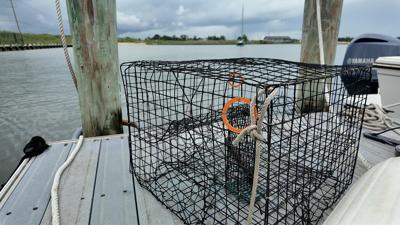

LEWES, DE. - The University of Delaware is taking part in a research program that detects lost crab pots on the floors of Delaware's bays by using sonar.
The program aims to locate and remove the derelict crab pots. Brittany Haywood, the Coastal Ecology Specialist with the University's Sea Grant office, said that the problem is a big one.
"There's an estimated 30,000 lost pots out there in Delaware's inland bays, which is about 20,000 acres," Haywood said.
Haywood also emphasized the importance this project has for the health of both the marine life and environment of Delaware's inland bays.
"[The traps] are still catching blue crabs even though there's no one there to reap the benefits," Haywood said. "So, they get trapped and unfortunately die."
The University showed WBOC a simulation on how they detect the crab pots. They threw multiple metal crab pots overboard, and then detected them with sonar equipment attached to the boat. The metal traps showed up bright orange against a dark radar background.
Jared Wierzbicki is one of the summer scholar interns working with the project. He said that he is working on travel kits for volunteering boats to attach and help map out lost crab pots along the bays.
"These crab pots that are left down there and no one knows where they are," Wierzbicki said. "In the future, we can take the sonar and we can find more crab pots, that's the idea."
Fabrice Vernon is the Dean of the College of Earth, Ocean, and Environment at the University. He said that he's grateful for how the program connects the schools research to local communities.
"And also to train our students to see that fundamental and high tech research can be applied to real world problems," Vernon said.
The University hopes to continue the program and raise awareness about the importance of collecting lost crab pots. Officials ask that those crabbing do so responsibly, and keep track of the crab pots they put in the water.
Those interested in getting involved with community programs or learning more can get in contact with the University of Delaware for more information.