
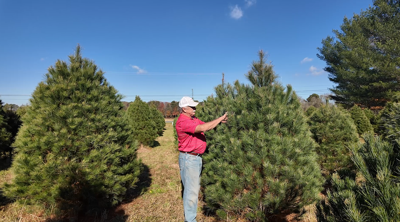

WICOMICO COUNTY, Md. — Before a Christmas tree ends up in a living room, it can spend more than a decade in the ground, and farmers on the Eastern Shore say one rough stretch can undo a lot of time.
Jay Bozman and his wife started P and J Tree Farm in 1980, the year their first child was born. Nearly 45 years later, the Delmar farmer says the biggest lesson is patience.
“What happens in this business is you have to be a really long-term person,” Bozman said. “So sometimes, you know, in a growing season, you're going to have a real dry season. Well, that might have been the second year of that tree's life. Well, that'll impact it for several years. Even if it doesn't kill the tree, it may only grow two inches that year instead of a foot because it was dry.”
Bozman said the trees families take home are older than many shoppers realize. He plants seedlings that are 2 to 3 years old, and they spend at least eight years in the field before harvest. That puts a typical tree at about 10 years old, counting its time as a seedling.
"All trees are like people. They all don't grow at the same rate," Bozman said.
Bozman added that Delmarva Christmas tree farmers face unique circumstances.
"The biggest struggle here is we don't have the soil types and elevation to grow. The Frazier firs, which are the most popular tree in the country. So we can't grow those," Bozman said.
Bozman instead grows white pines, Canadian firs and blue spruce on about 20 acres. For Fraser firs, he contracts with a farmer in the North Carolina mountains who grows the trees for him. A trucker then delivers the cut trees.
This year, Bozman said, the weather cooperated. Summer was hot and a bit dry, but he said enough rain fell at his farm that he did not lose any trees. In past drought years, he said, he has lost as many as 40% of the trees planted that spring. Typically, Bozman said he does not lose more than 5%.
The cost of fuel was harder to avoid. Diesel hit an all time high this September, surging over $6 a gallon. Bozman uses diesel to mow the grass between rows so customers who cut their own trees can walk the fields.
"It increased our mowing costs dramatically," Bozman said. He put the increase at about 40%.
He said he is holding prices close to last year's, but he expects shipping for North Carolina trees to cost $2 to $3 more per tree because of fuel.
Other threats are smaller but constant. Bozman said bucks rub their antlers on the trees, and birds break the soft new growth at the tops while building nests.
Over in Hebron, Bruce Nichols, owner of Nichols Tree Farm, said the challenges there are similar. Nichols has grown trees for about 45 years and planted his first one at 4 years old. Planting typically begins in March, but he said the work never ends.
"Oh, it never stops and never stops. It's always a continual ordeal," Nichols said.
Nichols said trees there take 16 to 20 years to prepare for harvest. He has installed 34 miles of irrigation to protect them after a drought years ago killed roughly 5,000 trees in a matter of weeks.
This year, the threat was a late frost rather than the summer's heat or drought. Nichols said it can set trees back a year.
"The late frost burns off all the new growth. The tree growth was probably two inches averaging and it burned it all off in the center," Nichols said.
Nichols also said too much rain can do more harm than good because it breeds fungus and disease.
Like Bozman, Nichols said time is one of the hardest parts of the job.
"Your main challenge is to outlive the time it takes to produce the tree," Nichols said.
Bozman said families come back year after year, and some now bring their grandchildren.
"We have families that come, and because we've been doing it so long, we have their children come and bring their children. So we have three generations of people who have been coming to our farms for over 40 years."
Bozman said shoppers should put a freshly cut tree in a water-holding stand and check it daily.