




For decades, Hollywood has produced films or television that's all about the dangers of artificial intelligence, or A.I. The greatest example has been James Cameron's The Terminator (1984), which is about a man who has to travel backwards in time in order to save the world from an A.I., which was going to wipe out humanity. That film had a twist that falls into what people consider a causality loop or temporal paradox. There have been many films that have dealt with this concept. One of the more stylish is Terry Gilliam's 12 Monkeys (1995), which seems to be a source of inspiration here. Gilliam's film is also about a man who travels back in time to save humanity, but from a virus. Gilliam took a more satirical and absurdist tone. It wasn't the horror and eventual action tone that Cameron utilized, even though Gilliam's film had some darker moments. Here, director Gore Verbinski (Rango and Pirates of the Caribbean: The Curse of the Black Pearl) is cribbing a little from both Cameron and Gilliam.
At the same time, a lot of the ideas here seem ripped from Charlie Brooker's series Black Mirror (2011). If you're familiar with Brooker's show, you know "black mirror" is a reference to cell phones. Brooker's Emmy-winning program isn't about cell phones. It's about what cell phones represent, the advanced digital technology, the social media, and the A.I., that has changed society in drastic ways. Verbinski's film is about all those same things, but, whereas Brooker invents new tech to embody those ideas, Verbinski instead just uses cell phones as the object of scorn and fear. Verbinski's film seems to push this particular fear about the danger of digital technology as inevitable and unstoppable, while embracing the notion of humanity being able to still fight back and never giving up.

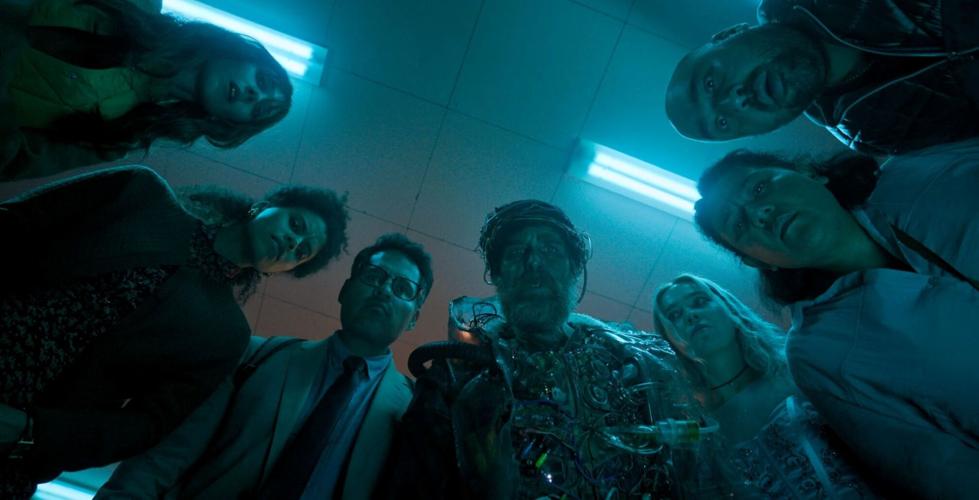
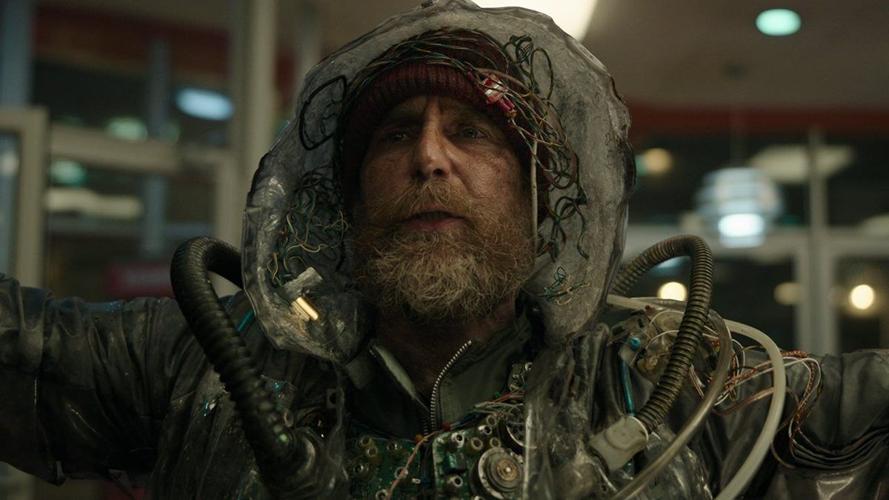
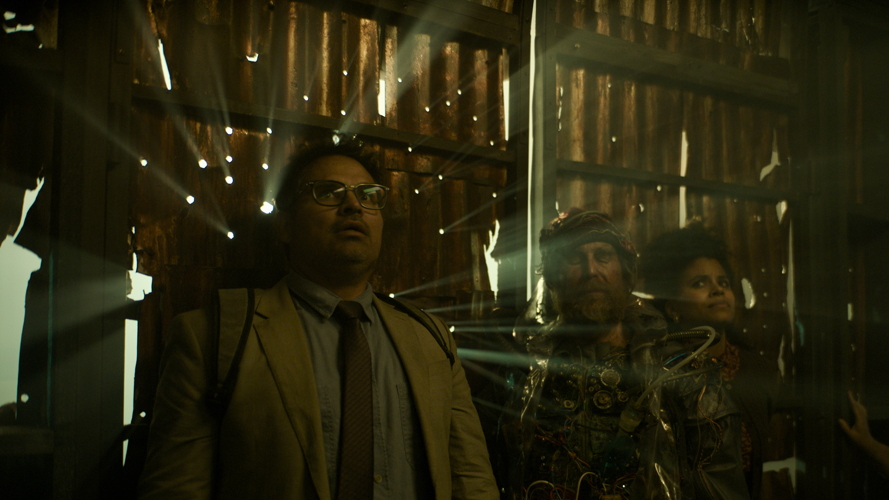
Sam Rockwell (The White Lotus and The Bad Guys) stars as an unnamed man who claims to be from the future. He looks homeless, dirty and unkempt. He looks like he crawled out of a garbage bin. He also acts like he just got out of a psychiatric ward. He's not unlike Bruce Willis' character in 12 Monkeys. It makes it easier to dismiss his claim of being a time traveler as nothing more than the rantings of a lunatic. However, it doesn't take long for the film to reveal some kind of science-fiction reality is at hand where time travel could be possible. There's no indication as to how time travel is possible or how this man had access to it, but that reality is established.
Of course, my inner nerd always starts to get skeptical anytime a time-travel story like this plays out. Rockwell's character says he's on a mission, a mission that he can repeat over and over, like in Groundhog Day (1993), and he can do so at will and at any time. Based on information he conveys later, it's not clear how he concocted this mission. However, his mission basically becomes similar to Sarah Connor's in Terminator 2: Judgment Day (1991), which was to kill the creator of Skynet, the A.I. that destroys humanity. Rockwell's character wants to do something similar. The difference is he doesn't want to kill the creator of the threatening A.I., but instead he wants to talk to that person and convince him to put safe guards on that A.I.

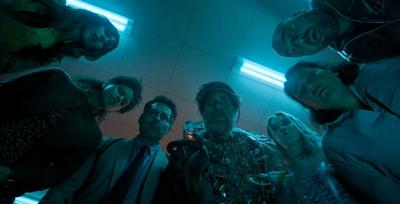
Therefore, Verbinski's film isn't arguing against A.I. completely. Its existence does seem to be an inevitability. The film simply argues for safe guards, even though there comes a point where those safe guards might not be enough. The critique here about A.I. aren't much newer than what we got in The Matrix (1999), which is that A.I. uses us, as it's essentially feeding off us, withering us away. Rockwell's character recruits a bunch of people to help him on his mission. The film gives flashbacks to their lives á la ABC's Lost (2004), to reveal why this bunch of people matter or why they're important, as well as how. Some of these flashbacks are like mini Black Mirror episodes. They feel like episodes in tone and literally some of the plots feel like ones Brooker has written. The only reluctantly fresh concept is one that depicts addiction or dependence on cell phones and social media as akin to turning people into zombies and not just anyone but specifically teenagers.
In terms of who's most susceptible or who's most at fault, this film aims its sights on young people, those under the age of 18. It does feel increasingly as if this film was made from the perspective of a Baby Boomer or even an older Gen Xer looking down at the younger generation with such disillusionment or even distaste, if not just confusion. What this film doesn't do is point out the cognitive dissonance of such a perspective. The truth is that all those young people have cell phones because their parents gave them cell phones. Most children don't have jobs or the money to pay for Apple's iPhone themselves. Their parents have to give them those phones. The idea that this film feels like older people scolding younger people doesn't quite jive. Yes, technically, Rockwell's character is supposed to represent the reverse, that of the next generation scolding the previous.

Yet, Rockwell is an actor who is nearly 60 years old, which means he could be considered either an older Generation X or a young Baby Boomer. Therefore, the message coming from him who appears to be the Verbinski proxy comes across as a kind of cognitive dissonance or an abdication of responsibility. There are younger actors and characters in this film who make more sense as the messenger here. Zazie Beetz (The Bad Guys and Deadpool) co-stars as Janet, a high school teacher who also becomes disillusioned at her students constantly being on their cell phones. Beetz is in her early 30's. She would be considered a Millennial, so having her deliver the message or be the time traveler would have been better, if not more interesting.
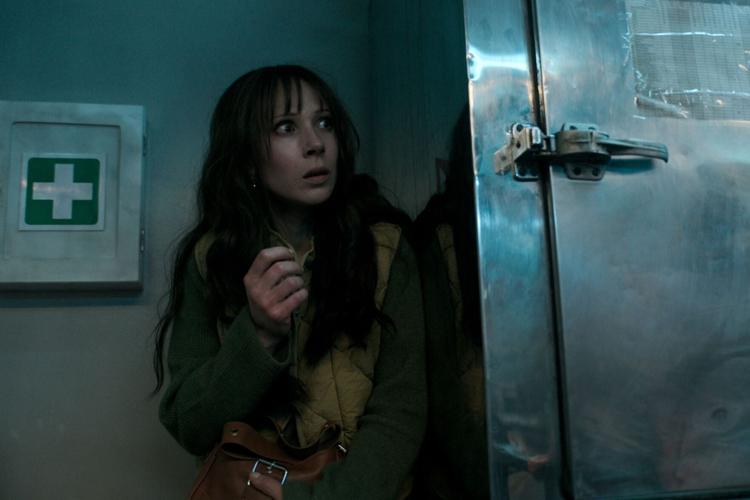
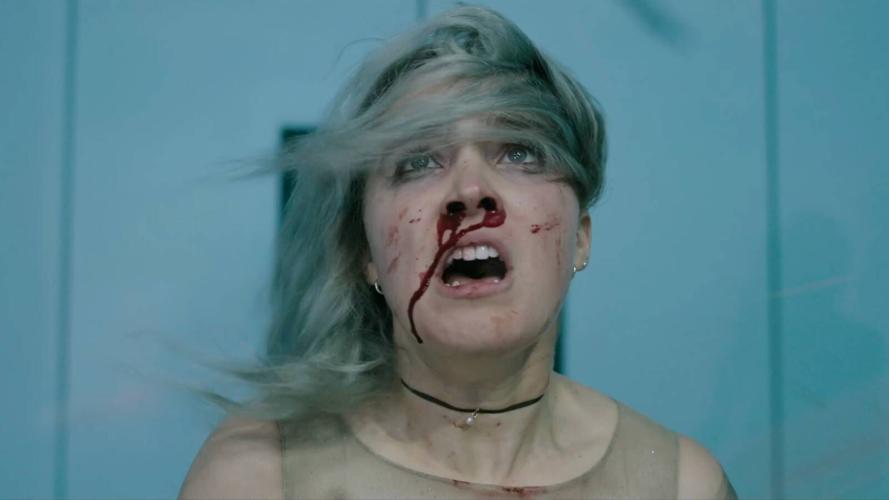
Rockwell's character recruits Janet, as well as a bunch of others. One of whom is Ingrid, played by Haley Lu Richardson (The White Lotus and After Yang). She was in her late 20's when she made this film. She's technically on the older side of Generation Z, often called "Zoomers." She would be apart of the same group of people who are being critiqued the most and portrayed as zombies. Zoomers as zombies is the metaphor here, but Ingrid is an exception because she has an electromagnetic hypersensitivity or EHS. If one has seen Better Call Saul (2015), it's the same condition that Michael McKean's character had. McKean's character never goes outside because, as a character in this film points out, there's electromagnetic signals everywhere. It's in the air, so a person with EHS wouldn't be able to function anywhere, certainly not in a major city like Los Angeles. She would have to live in an isolated or rural area where there were fewer or no cell phone towers. This film wants us to buy Ingrid having EHS but still living and functioning in L.A., which is a cheat.

Verbinski amps up the dark humor, exaggerating things into a hyper-reality in order to underline the ridiculousness that Boomers and Gen Xers see in current digital technology, particularly interactions with social media. The dystopia imagined seems so silly and abstract that I'm not sure it will convert anyone not already anti-artificial intelligence. Also, I think that what this film misses is that while A.I. is the object of scorn. Inherently, what the arguments end up being are arguments against capitalism. Social media are controlled by tech companies that are simply acting in aggressive capitalist ways. The addiction and dependence to the product of social media is no different from the addiction and dependence that Coca-Cola wants for its customers. Any remedies will only come from laws and political movements to push back. Rockwell's character should not have appeared in some random diner in Los Angeles. He should've appeared in Washington, DC and gotten elected officials to enact legislation.
Rated R for language, violence, some grisly images and brief sexual content.
Running Time: 2 hrs. and 14 mins.
In theaters.