






Over the past decade or more, the Academy Awards has reportedly taken extra steps to diversify its voting body. Particularly, the number of international voters has increased. We've seen certain evidence of that with something like Parasite (2019) winning Best Picture. Since then, there have been a number of films that have not only been nominated for Best International Feature but also Best Picture. In fact, the past five years have seen that happen with the past two years seeing two international features make it into the Best Picture category. Joachim Trier is a highly acclaimed filmmaker from Norway. This is his sixth feature and almost all of them have been submitted to the Academy Awards. His previous film, his fifth feature, The Worst Person in the World (2021) was his first to get nominated here in the United States. It got Trier a nomination for Best Original Screenplay. It was really beloved in the critical community. Trier played to the Oscar crowd and has now delivered a film that has garnered nine Oscar nominations, including Best International Feature, Best Film Editing, Best Supporting Actress (twice), Best Supporting Actor, Best Actress, Best Original Screenplay, Best Director and Best Picture. Not since Crouching Tiger, Hidden Dragon (2000) with ten Oscar nominations has an international feature been this highly regarded.
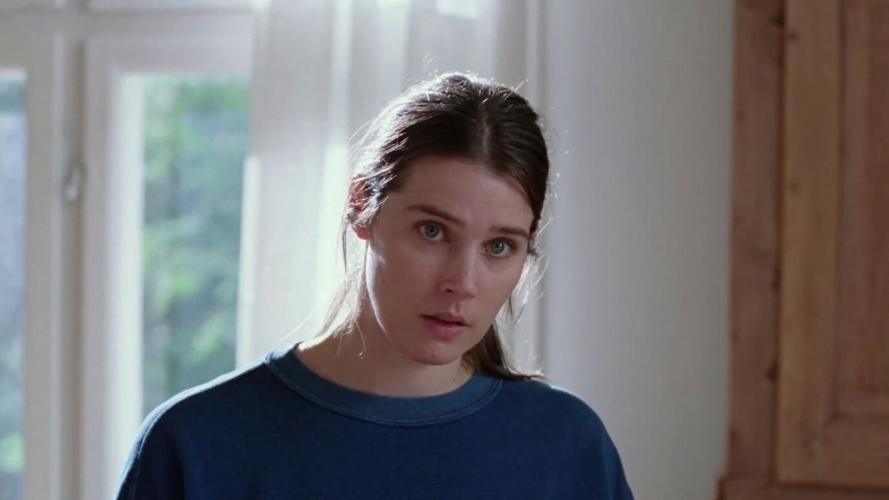
Renate Reinsve (A Different Man and The Worst Person in the World) stars as Nora Borg, an actress from Oslo, Norway. She's mainly and seems like strictly a stage actress, doing live theater exclusively. However, she seems to suffer from stage fright. Before a performance, especially a premiere performance, she gets incredibly anxious, resulting in a full-blown panic attack. She literally tries to rip off her costume and run out of the theater mere moments before the curtain opens, and even after the curtain opens. She enjoys acting, which is why she keeps doing it, but there's something about her that is sad. She could even be described as depressed. This is understandable, given that the majority of this film takes place in the wake of her mother's death. Yet, it becomes clear that there's something else deep down that is affecting her.

Inga Ibsdotter Lilleaas (A Beautiful Life) co-stars as Agnes Borg Pettersen, the younger sister to Nora. Agnes did some acting when she was a child, a teenager, but she didn't pursue it any further. She ended up getting married and having a son. She's not as depressed. In fact, she doesn't seem sad at all. She doesn't have the same issues, despite growing up in the same household, which is a point in conversation that she and Nora have. How Nora and Agnes grew up and what it was like for them in their specific household is arguably the whole point of this narrative. The opening of the film is a beautiful montage that felt like something out of Terrence Malick's The Tree of Life (2011) where we see the childhood of both Nora and Agnes, but also the history of the house where they grew up and that has been in their family for generations. That montage is also a better and shorter version of Robert Zemeckis' Here (2024).
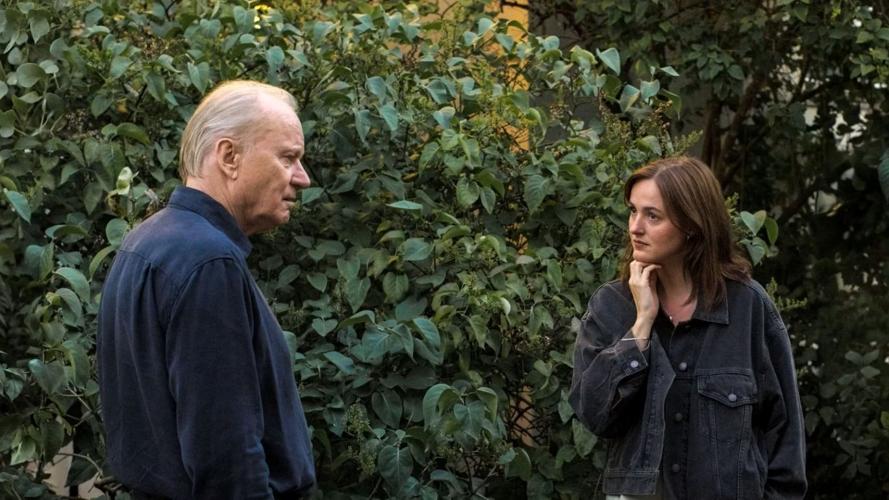
Stellan Skarsgård (Dune and Thor) also co-stars as Gustav Borg, the father to Nora and Agnes. However, as we learn, Gustav had troubles in his marriage. He split up with Nora and Agnes' mother. That divorce clearly had an impact on his daughters. He had frequent fights with their mother, which is described as the "noise." It got to a point where Gustav was an absentee father or his children, specifically Nora, accuse him of being an absentee father. He never disputes it, so it's assumed to be true. This is unlike George Clooney in Jay Kelly (2025) who was accused of being an absentee father but the film tries to whitewash that or paint Clooney's character in a more sympathetic light. Trier has no such inclination to whitewash, at least not until the ending, which could be interpreted in various ways.

Gustav has written a script that he wants Nora to star in. Nora refuses because of the strained history. She still harbors anger and resentment toward her father for him being so absentee. She doesn't even want to spend time with him. She does so for her sister's sake, but she doesn't even want to talk to him, let alone work with him. There's a suggestion that Gustav is so wrapped up in his art, his filmmaking, that everything else, including his children, take a backseat. It's possible that he values his art more than he values his children. He doesn't seem like a total monster, although someone realizing that they're not cut out to be a parent isn't necessarily a bad thing, and it doesn't seem as if he ever denied his responsibilities. It's also arguable that him including his daughters in his filmmaking is him trying.
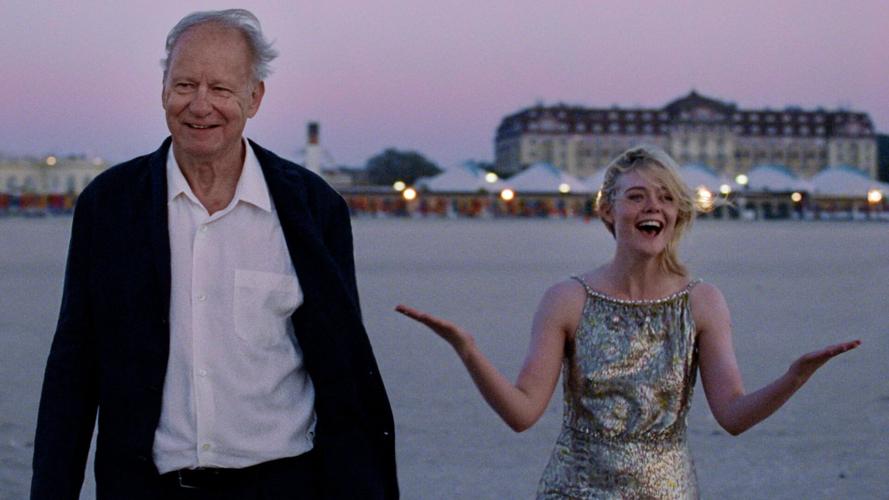
Elle Fanning (Predator: Badlands and Maleficent) rounds out the cast as Rachel Kemp, an American actress who meets Gustav at a retrospective film screening in France. She invites him to dinner. Gustav then asks her to be in his film where she would essentially play the character inspired by Nora. She's not sure that it's inspired by Nora. At first, Rachel thinks that the character is inspired by Gustav's mother. She wants to play the role as best as she can but not knowing who the true inspiration is becomes a problem for her. She worries that she'll disappoint Gustav and not give him the best performance or what he truly wants.

Speaking of Gustav's mother, named Karin, there is an aspect that what happened to her and what she did might have had an effect on him. It's not clear if Gustav's mother was Jewish or not, but she was a victim of the Nazis. She was tortured at the hands of the Nazis, and Agnes goes to a library or research facility of some sort and pulls the evidence. We see records and photographs of Nazi torture. Karin survived the physical abuse, but the emotional and psychological toll stayed with her for the rest of her life. This toll, though not exactly the same, could've been passed down to Gustav in some fashion, as well as to Nora. The conclusion is that perhaps in a way Gustav is making a film about both his daughter and his mother, which puts this film on the same plane as Pedro Almodóvar's Pain and Glory (2019), just not as gay, although it's revealed that Gustav's aunt was likely a lesbian.
Rated R for some language, including a sexual reference and brief nudity.
Running Time: 2 hrs. and 13 mins.
In select theaters and available on VOD.