




When it comes to horror films, and specifically slasher flicks, the convergence of sex and death has always been a thing. If you watched Scream (1996), which was a satire of slashers, there was a lot of commentary about how sex often leads to death. The punishment for sex is death in those features. Slashers are often about serial killers using knives or stabbing weapons, which are interpreted as phallic symbols. The deaths are depicted as violent, penetrative acts, which sex, though not necessarily violent, is a penetrative act. Both of which result in a release of bodily fluids, be it reproductive fluids or vascular ones. One penetrative act is meant to give life and the other is meant to take away life. Intercourse and murder have always been seen as two sides of the same coin in cinema. Usually it's the subtext of horror flicks. Here, writer-director Jane Schoenbrun makes it text. Instead of being an undercurrent, Schoenbrun puts that convergence in big, bold letters, right in your face.
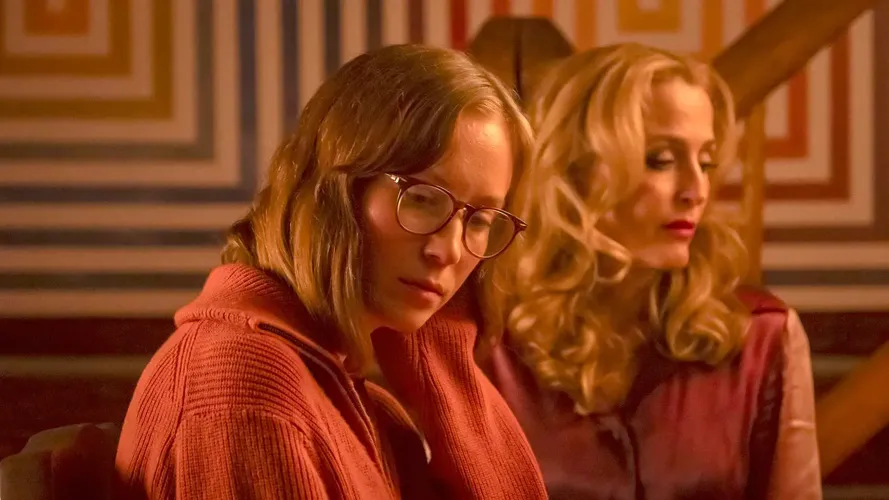
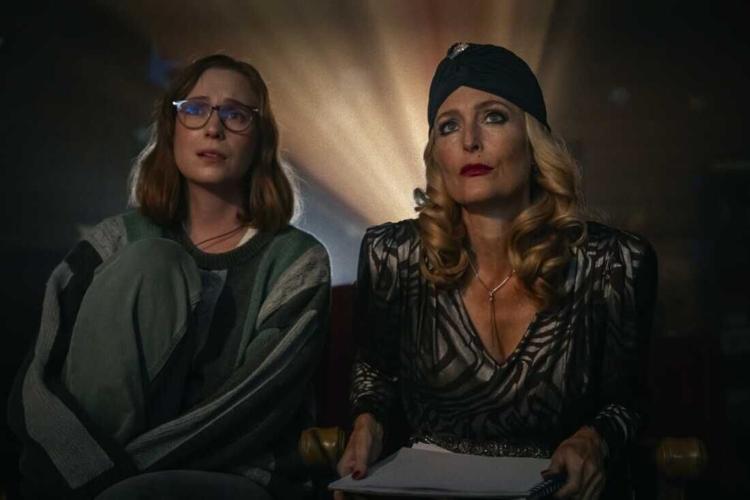
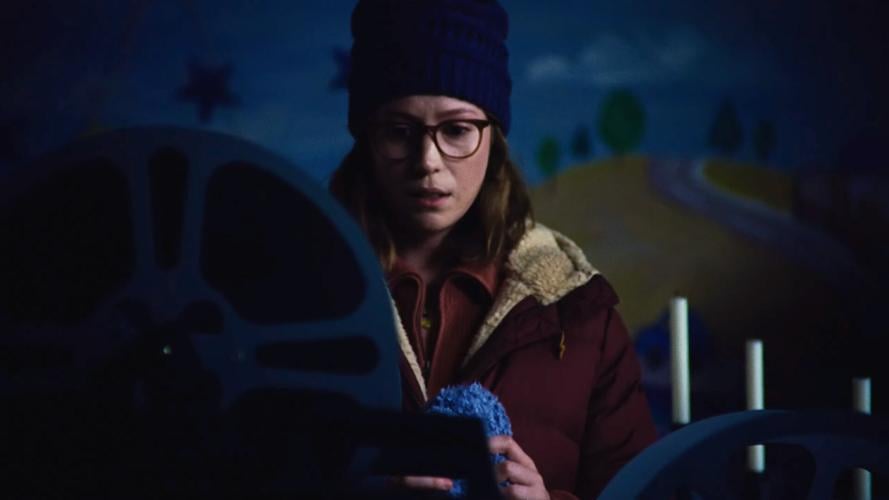
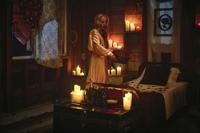
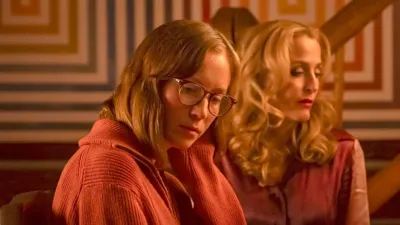
Hannah Einbinder (Hacks and Strange Planet) stars as Kris Williams, a young filmmaker hired to direct a reboot of a 80's horror franchise that was akin to Friday the 13th (1980) or other similar slashers. She goes to the actual sleep-away camp where the franchise was filmed. She's hoping to be inspired because she has to make a pitch to Hollywood executives about what the story of the reboot is going to be or what the look and structure are going to be. While there, she realizes that there is a scene from that 80's slasher where the actress has a particular look in her eye in a scene where the actress' character is murdered literally while in the act of intercourse. Kris is attracted to this scene, but she's not sure why.

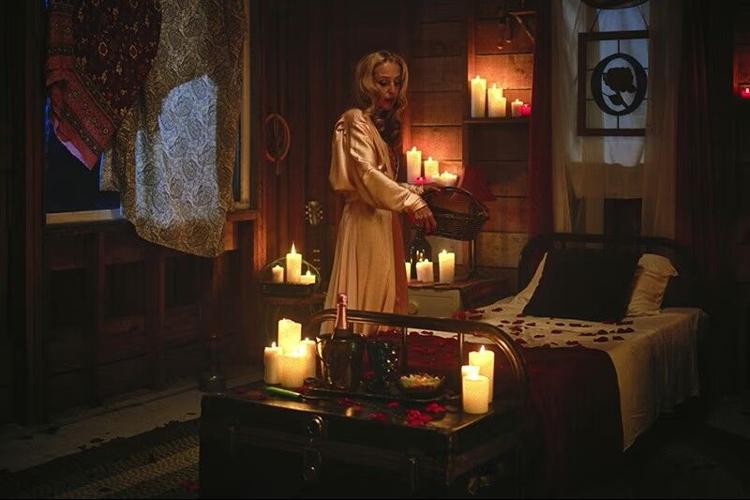
Gillian Anderson (The Crown and The X-Files) co-stars as Billy Presley, the aforementioned actress who starred in the 80's horror flick in question. After doing that film, she rather disappeared, basically becoming a recluse and feeling rather rejected from Hollywood. Kris realizes that Billy has been living alone in the sleep-away camp where her film was made, almost like a ghost haunting it. There is a Norma Desmond aspect to her but also there's a kinship to Demi Moore's character in The Substance (2024). Billy might not be desperate to hold onto her youthful looks, but there is an aspect from her youth to which she clutches.
Schoenbrun's previous two features were arguably about identity and mental health. This film could be deemed self-same, but there is a focus on sexual expression and particularly sexual satisfaction. Depicting women receiving gratification during intercourse or otherwise has been lost in some ways in cinema. Yes, sexual attraction or lust has been depicted where the gaze is often focused on a shirtless male body. Here, Schoenbrun turns the attention back to sapphic pleasure. Many women have complained of not even achieving orgasm during intercourse, often with males, and the depiction of such, or lack thereof, has been a trope in Hollywood, less it be deemed dirty as the documentary This Film Is Not Yet Rated (2006) proved.

There have been two films this past year that have invoked this idea of BDSM relationships. Harry Lighton's Pillion (2026) and Gregg Araki's I Want Your Sex (2026) have been those films. Lighton's film was about a BDSM relationship in a more direct way. Araki's film was about a BDSM relationship in a more indirect way. It was a tiny aspect as opposed to being the central thing. Schoenbrun's film is indirect or tangential about its BDSM aspects. In BDSM, the S&M stand for "sadism" and "masochism" or sadomasochism, which is one's sexuality being centered around giving or receiving pain, control or humiliation, or role-playing such. Lighton and Araki's films leaned more toward control and humiliation. Schoenbrun's film leans more toward pain, or the ultimate expression of pain, that of murder and death.
In fact, the serial killer depicted in the film-within-a-film here is nicknamed "Little Death." It's been pointed out that "little death" is the literal translation for the French term "la petite mort," which is what the French use to describe or reference an orgasm. Essentially, what Schoenbrun does is make that term or concept literal. What if a person could only orgasm, if they were literally murdered. Unfortunately, Schoenbrun's film isn't an actual exploration of this concept. It's not like Lighton's film, which scratches the surface of its BDSM relationship, but arguably is deeper than where this film goes. The concept of "la petite mort" is more or less the punchline to a protracted joke here, as opposed to being the true subject of it. I say joke because the ending to this film feels like it veers into Saturday Night Live style comedy, and that's not just because of the presence of Sarah Sherman, a SNL alum, or Zack Cherry, another comedic actor cast here.

Rated R for bloody violence, gore, sexual content, graphic nudity, drug use and language.
Running Time: 1 hr. and 52 mins.
In theaters.