
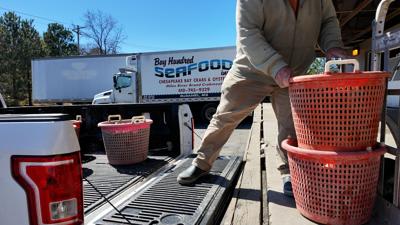

TALBOT COUNTY, Md. -- Watermen on the Eastern Shore have been struggling, but as an extended oyster season winds down, there could be a silver lining. Proposed legislation aims to restore long-neglected oyster sanctuaries.
Watermen Jeff Harrison said it's an effort that's greatly needed.
"All of the sanctuaries are not doing anything, they're not performing at all," said Harrison. "They have very few to no oysters on them."
Now, poorly maintained sanctuaries were not the main reason watermen struggled this year. Harrison said poor oyster markets and bad weather should bear most of the blame.
In fact, Harrison said outside of Maryland's oyster sanctuaries, oyster populations looked really good this year.
"We've got plenty of oysters out there, my God, everybody out there, please eat some," said Harrison.
His claim received timely support from Maryland's Governor Wes Moore, who announced on Monday that oyster reproduction has reached historic levels.
According to the Maryland Department of Natural Resources, concentration of new oysters in 2025 was nearly six times higher than the long-term spatset average. It was also the second-highest ever recorded in the 41-year history of the state's annual fall oyster survey.
Certain sanctuaries, however, still need help, and that's exactly what SB 875 aims to do.
If passed, the legislation would implement a rotational harvest pilot program. The program would focus on four designated areas of the Chesapeake Bay:
- The Lower Choptank River Sanctuary
- The Lower Main Stem Chesapeake Bay Rotational Harvest Area
- The Holland Point Oyster Bar in the Herring Bay Rotational Harvest Area
- The Hickory Thicket Oyster Bar and Hunting Field Oyster Bar in the Lower Chester River Rotational Area
Of course, the Lower Choptank River Sanctuary hits closest to home.
Through this pilot program, watermen would essentially be able to help themselves.
"We'll take our funds and we'll plant spat on shell, or shell, or seed in these areas, and we'll do three sections.
This would work in three-year cycles. For example, an oyster bar opened by DNR in the 2026-2027 season could be harvested in 2029-2030. The idea is to give each section a break, allowing oysters to repopulate and grow.
"We can maybe not harvest them one year, wait another year, and we get a bigger oyster out of it," said Harrison. "Our markets have been a little tighter now, and you know, we'll have a product that everybody wants."
Senator Mary Beth Carozza (R), one of the sponsors for SB 875, said the legislation is based on a proven strategy. According to Carozza, the Swan Point Oyster Bar in Kent County was restored using the same method beginning in 2014.
Guy Spurry, another waterman we spoke with in Talbot County, said he's also seen similar methods used in the Potomac River.
"They got three different boxes, one box is open this year, and then that's shut down. So, it's working down there, just as long as too many boats don't show up at one time," said Spurry.
According to the bill, DNR will be able to adjust catch limits, limit the days and hours of harvest, and restrict the gear watermen can use.
SB 875 passed the first reading in the Senate. A hearing is scheduled for Mar. 10 at 1:00 p.m.