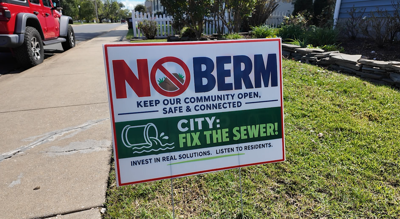


CAMBRIDGE, Md. — Organizers of two of Cambridge's biggest annual events say a proposed flood barrier along the city's waterfront could force them out of town. City officials are now pricing a version of the project without it.
The city has been weighing a berm, essentially a raised earthen flood wall, along the Choptank River shoreline as part of theirFlood Resiliency Project. According to city engineer Joel Leifer, Cambridge has been approved for FEMA funding for the project but still needs to submit a design that the agency signs off on.
Speakers at Monday's commissioners meeting largely opposed the current plan. Two speakers in particular said the berm would cut through Gerry Boyle Park, where both events are based.
Brian Snow, race director for Ironman Maryland and Eagleman 70.3, said the park is the only one in the area that can handle the races' operations. Athletes need to reach the water, emergency vehicles and trucks, he said, and a berm would get in the way.
"The issue with the berm, is that you have to climb a berm,” Snow said. “The athletes need to be able to access trucks, need to be able to access emergency response. You need to be able to access the water and the land. If there's a berm that we have to climb, then it's not an Ironman. It's an adventure race and we don't produce adventure races.”
Snow said exhausted athletes could not safely climb a berm several times during the race. He said Ironman Maryland is in its 12th year in Cambridge, and Eagleman passed its 30th last year. Ironman's contract with the city runs through 2028, and Snow said a corporate decision to leave over the project is possible. Losing the races, he said, "would be a catastrophic blow for the area."
Snow said he would support a plan that organizers and other stakeholders help shape. He said he had raised concerns with the project team nearly two years ago and never heard back.
The Cambridge Classic Powerboat Regatta, now in its 116th year, would also be at risk, according to event organizers. Cambridge Powerboat Racing Association Committee member Bill Christopher said the park was built in the early 1970s to support the races, which draw 50 to 70 boats from around the world. Cranes lift the boats into the water from piers along the park.
Christopher said the berm would take up roughly a third of the space used to stage boats, and that racers' RV-towed trailers might not be able to get over it. He also said the Cambridge Powerboat Racing Association has been described publicly as endorsing the plan, which he said is not accurate.
"We understand flooding is an issue,” Christopher said. “Obviously flooding gets us when we try to have races down here. Obviously with the boats coming in, and obviously the worry about a storm. I understand the impacts of that. The question is, is the berm the only potential option and where it's placed is it the correct option. Current placement right now would prohibit the races from happening because we would not have a place to put the boats."
He said the berm would also divide Long Wharf Park, which is another concern for residents.
City Engineer Joel Leifer said he has been directed to ask the project's design contractor, Bayland — an environmental consulting firm — for a cost proposal on a stormwater-only plan. That version would drop the berm and the living shoreline and try to reduce disruption to both parks. It would pump stormwater out to the river at either end of the city.
FEMA weighs whether a project's cost is justified by the storm damage it would prevent, Leifer said. That calculation is called a benefit-cost analysis. The stormwater piece alone scores 0.6, and a project needs at least 1.0 to qualify. A redesign would need larger pipes and pumps to move more water, he said.
“We need it to be at least 1.0,” Leifer said. “So this new task is for Bayland to look at the design, come up with a new cost. And then we need to look at the benefits so we could see if we could, reach a benefit cost analysis greater than one. If, you know, if we can or if we can get close, we can submit it to FEMA.”
Even a score of 1.0 would not guarantee FEMA's approval, Leifer said. He said FEMA would cover 90% of the cost, and other grants might be available.
The December submission target is not a hard deadline, Leifer said. The city chose it to give FEMA its usual nine months to review the design and leave time to build. The federal money is now set to run out in summer 2028, after the completion date was extended for projects across Maryland.
“This money is presently configured due to run out, summer of 2028. Okay. So what that means is we have to have a design submitted to FEMA, have FEMA review it and approve it, release the money for construction and have the design finished before that. So the sooner we can get this work, the design in, the sooner we could start on the next phase of it…The city is committed to figuring out a solution that the city can afford and the residents will accept," Leifer said.
Commissioners voted unanimously at the city council meeting that followed the public hearing on Monday to extend the hazard-mitigation grant – which is awarded in connection with the City’s Flood Resiliency Project – through August 2028, keeping up to $16 million in potential flood-mitigation funding available. This vote does not mean approval of the current design.