
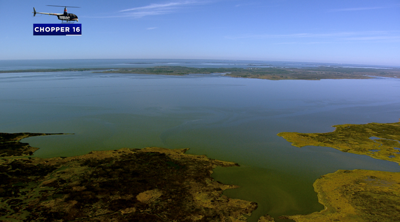

MARYLAND — The 2026 Chesapeake Bay and Watershed Report Card shows the Bay has earned its highest grade in 40 years, but researchers and watermen say challenges remain.
The Bay received an overall grade of C-plus, or 56%, with improvements in several water quality indicators. However, water clarity remains the Bay’s lowest-scoring indicator, and the Lower Eastern Shore is one of two watershed regions showing a declining water quality trend.
Michael Basil, a Talbot County waterman, says there is still work to be done to improve the Bay’s health.
“There's still a lot of work that can be done,” Basil said.
Basil says pollution from development and nearby communities remains a concern.
“You've got waterfront homes everywhere, fertilizer, sewage coming from cities, towns,” Basil said. “I mean, you're never – it's never going to be what it was hundreds of years ago. But if we can improve it, I mean, any little bit helps.”
William Skipper, another Talbot County waterman, says weather conditions can influence the Bay’s health from year to year.
“We didn't have a lot of runoff,” Skipper told WBOC. “So, you know, that's probably it. It's...nothing but Mother Nature. You ain't going to mess with Mother Nature. She does what she wants.”
Skipper says the Bay’s health matters to both watermen and the people who depend on locally caught seafood.
“it's important to the waterman, number one. It's important to the people who live here because most of more local produce, you know, they want local corn, they want local crabs, oysters, fish,” Skipper said.
He says older watermen have long recognized how much nature influences their work.
“You talk to older watermen who've been doing it since before, you know, they were old enough, go to school with their fathers and grandfathers, and they'll tell you the same thing. It’s all up to Mother Nature,” Skipper told WBOC.
Mason Little, who owns Choptank River Crab & Oyster Co. in Cambridge, says the report’s findings are encouraging for the seafood industry.
“It's always good news to hear that it's improving,” Little said. “And, you know, that always means better longevity for the seafood industry. So that's what we want to hear.”
Dr. Heath Kelsey with the University of Maryland Center for Environmental Science says the long-term improvements show that efforts to protect the Bay are making a difference.
“We are moving in the right direction,” Kelsey said. “So I think we should be optimistic in that regard. But also not take our foot off the gas…What we're doing is working. Let's keep doing it.”
Researchers say relatively dry weather in 2025 helped limit the amount of pollution washing from the land into local waterways. They also credit ongoing restoration efforts for the Bay’s long-term improvements.
The report shows the Bay’s overall health has improved over time, though progress varies across the watershed. Researchers say continued efforts to reduce pollution will be key to building on those gains.
A link to the report's findings can be found here.