
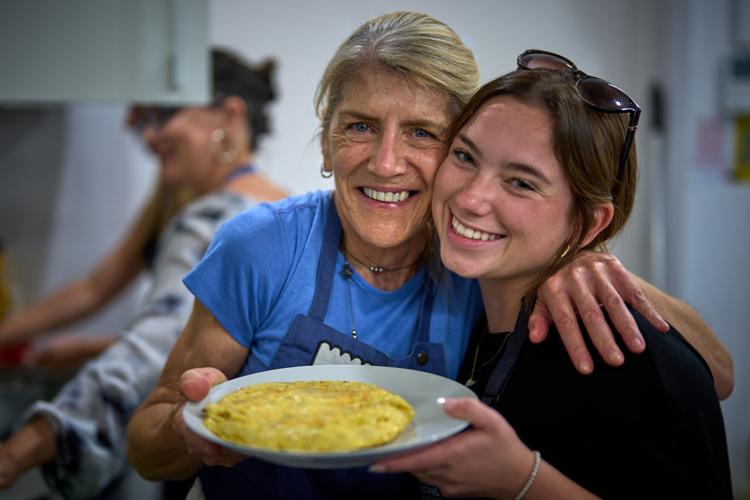
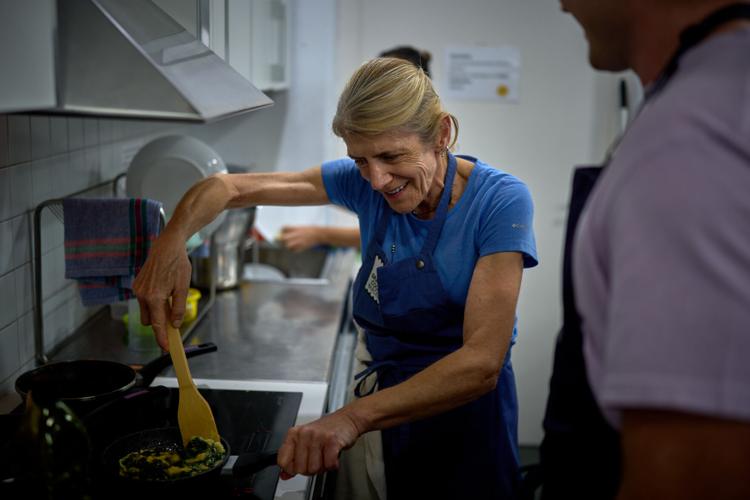
BARCELONA, Spain (AP) — Once the potatoes are cooked and the eggs half set, Sonia Castel places a plate over the sauté pan and instructs one of her students to grab the handle.
Castel, 63, thrums on the counter for a drumroll as Mason Kauffman, one of a group of American exchange students in the cooking workshop, holds the plate steady and steels himself to flip the pan. After a countdown of 3, 2, 1, cheers erupt as he makes the flip, sliding the eggs back into the pan to finish cooking a Spanish tortilla, or omelet.
“I was so nervous,” says Kaufmann, a junior at New Hampshire's Plymouth State University, smiling broadly.
After each student has a turn, Castel pulls them into a hug and practically demands a kiss on the cheek. “You have to pay for the lesson!”
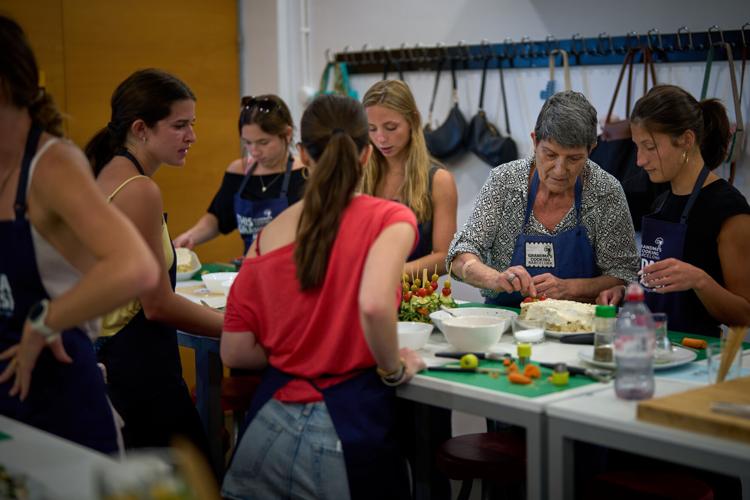
The workshop at Grandmas Cooking Barcelona offers tourists, schools and other visitors “authentic Barcelona cooking classes with local grandmas and grandpas.” It aims to share traditional Spanish and Catalan dishes and techniques that have become harder to find in the city's restaurants.
The benefits run both ways. The program helps provide purpose to older people who might be struggling with loneliness, says its founder, Veronica Baena.
Visitors can learn to cook the way grandma might
“Yes, it’s a gastronomic experience, but above all it’s about the empowerment of older people,” says Baena. “The idea was to try to recover their own personality, their own selves and integrate them into the international Barcelona.”
Baena founded Grandmas Cooking Barcelona in 2017 after seeing grandparents dropping off and picking up grandchildren at her son’s school. She learned some didn’t have much else going on in their lives anymore, so she invited a couple of them to cook at her house. Now, there are 20 older women — and one man — who share cooking tips, life lessons and more than a few jokes at civic centers, social service organizations and other locations in the city.
Passing down kitchen wisdom helps the ‘grandparents,’ too
Early on, Baena recruited a friend’s neighbor, Nuria Isanda, because of the irresistible aromas wafting from her kitchen window.
Isanda, 75, said her recipes are rarely found these days in a city whose restaurants increasingly cater to tourists. Such dishes cooked by older people might not even be appreciated by their own families, who may visit on weekends and “don’t even thank them for the food.”
The workshops, Isanda says, "can be the platform that makes grandmas feel valued and useful.”
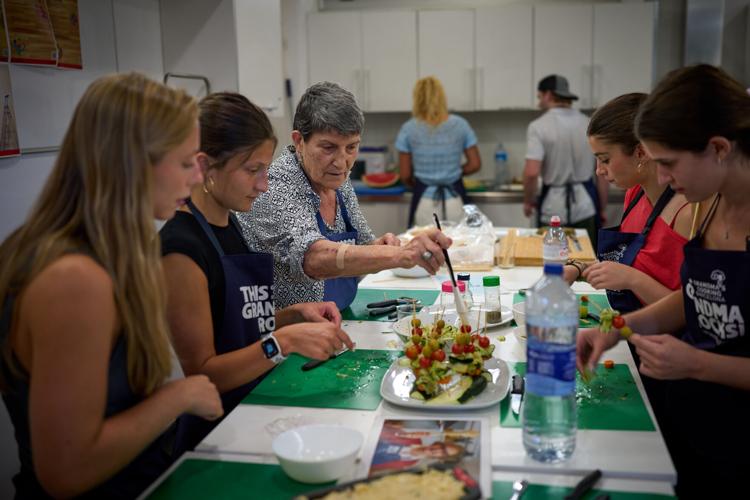
At the recent workshop for study-abroad students, held in a rented kitchen at a civic center, Isanda showed them how to make zucchini ribbons, thread them onto skewers and dress them with a vinaigrette. Students also smeared crackers with goat cheese and blueberry jam, or decorated ensaladilla rusa, a potato salad laced with hard-boiled egg, chopped pickles and tuna.
Don't crack eggs on the bowl, and other tips
Isanda and Castel passed along cooking tips, like to always crack eggs on a counter, not the edge of a bowl, to keep out the shells.
They also stressed the sustainability of traditional cooking. For example, don’t waste anything, even carrot peels, onion skins and the ends of cut vegetables. Save them in a bag in the freezer. When the bag is full, make vegetable stock.
Castel joined Grandmas last year after retiring from a career in hospital admissions. Relating with so many foreign people has made her feel more connected and “more alive.”
“The joy of sharing food is a social act, and they leave happy,” she said. “Grandmas gives me that, and you can’t put a price on it.”
Albert Stumm writes about travel, food and wellness. Find his work at https://www.albertstumm.com