
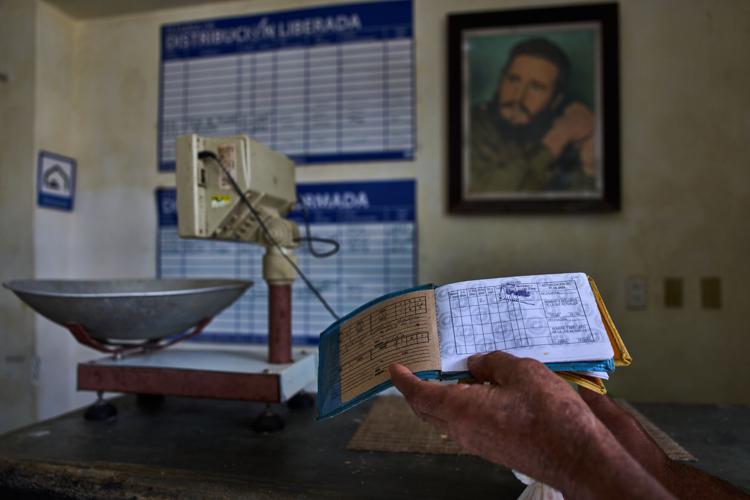
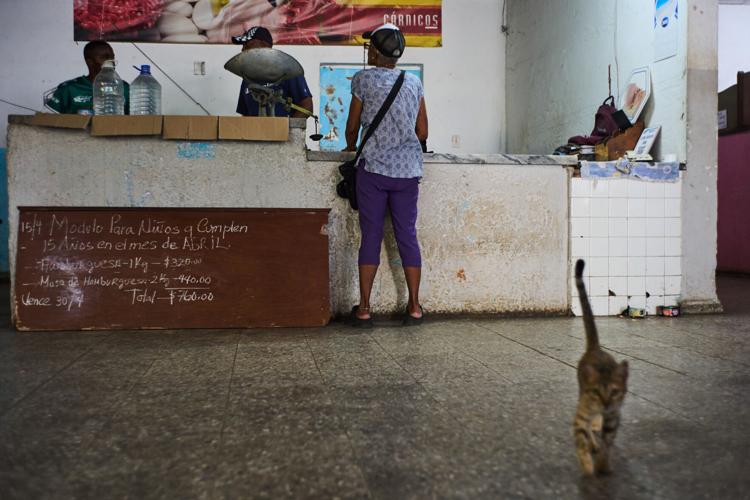


HAVANA (AP) — José Luis Amate López hasn’t had a customer in almost two weeks, not counting the scrawny brown kitten that slinks around the bodega where he works in central Havana.
The shelves once laden with goods during his childhood sat nearly empty in late April, with barely anything to offer the 5,000 clients who depend on the state-run store for subsidized food.
Government ration books that once provided for a healthy diet and kept families fully fed for a month are now shrinking.
As the economy collapses and prices soar, a growing number of Cubans find themselves unable to afford alternatives to state-run stores and struggle to subsist on meager salaries in a socialist country of nearly 10 million where basic goods increasingly are sold in U.S. dollars.
“No Cuban can truly survive on the products from the ration book anymore,” Amate López said.
‘Living
off air’
Revolutionary leader Fidel Castro established the ration book — “la libreta”— in the early 1960s. It offered heavily subsidized goods ranging from milk to fish and even cigarettes. Cubans knew their assigned bodega would be stocked with everything they needed by the first of the month.
The ration book shrank during the “Special Period,” when Soviet aid plummeted in the 1990s and deprivation hit Cuba. During that time, Cubans lost an average of 5% to 25% of their body weight, according to one study published in a medical journal, with goods including bread, milk, eggs and chicken in scarce quantities.
Even so, many Cubans who lived through that period say the current situation is worse.
Amate López recalled that his assigned bodega was so full decades ago “you could barely walk.”
It’s now an empty room with dusty old posters detailing the prices and amounts of nearly two dozen goods no longer available, including yogurt, pasta and bars of soap. Two industrial freezers once packed with meat and chicken serve only to keep Amate López’s water bottle cold. In April, the only items he had available to sell were rice, sugar and split chickpeas.
Cuban teens turning 15, a landmark birthday in Latin America, used to receive cake and several cases of beer. Now they only get 3 kilograms (6.6 pounds) of ground beef. The government recently opted to celebrate those turning 65 by awarding them sardines, a bar of soap and a package of toilet paper. But Amate López said he doesn't have those items.
Havana resident Ana Enamorado, 68, said she only was able to buy split chickpeas and 2 pounds (1 kilogram) of sugar at her assigned bodega in April.
She struggles to buy the remaining basic goods at small, privately owned stores known as “mipymes” with her salary and pension totaling some 8,000 Cuban pesos ($16) a month.
A carton of 30 eggs costs roughly 3,000 pesos ($125), 2 pounds of meat hash are nearly 900 pesos ($37) and 1 pound of cornmeal is roughly 200 pesos ($8).
“There’s hardly anything in the ration book,” she said. “We’re practically living off air.”
Her lunches and dinners are a rotation of rice, seasoned ground meat and cornmeal, or sometimes nothing at all. She recalled once upon a time being able to eat pork, lamb, fricassee, fried plantain slices and red beans and rice.
“Now we have to cut back, have one meal a day and live on memories,” Enamorado said.
Subsidizing people in need instead of goods
Cuba imports up to 80% of the food it consumes, including goods offered at state stores that are increasingly unavailable given a lack of government resources.
“They just don’t have the money to do it anymore,” William LeoGrande, a professor at American University who has tracked Cuba for years, said about the government running out of funds. “Things come in an ad hoc way.”
LeoGrande said the government “bungled” the 2021 merging of two Cuban currencies and the resulting inflation has persisted because the state spends far more money than it takes in.
The government has to stop printing money and balance its budget without drastically cutting social services, a challenge since the bulk of state funds is spent on health, education, social welfare and food imports, he said.
“Any major cuts in state spending are going to have a profound social impact, which is why they haven’t done it,” LeoGrande said, adding that the government’s investment in tourism is “way higher” than the demand for tourism, which has plummeted.
In recent years, Cuba’s government has talked about subsidizing people in need instead of goods. That would free up money to import fuel, medicine and other items, LeoGrande said.
But many Cubans still depend on their ration books while the island's crises deepen as severe power outages, petroleum shortages and a U.S. energy blockade persist.
Cuban comedians have spoofed the ration book, creating a character named “Pánfilo" who sings a rhyming chorus in a recent video posted online: “Place the notebook in a cemetery, because it's ready to be buried.”
Struggling to buy basic goods
On a recent sunny afternoon, Lázaro Cuesta, 56, stood in line to receive a daily allowance of two small bread rolls for him and his wife.
“Before it was 80 grams and cost 5 (Cuban) cents. Now it’s 40 grams and costs 75 cents,'' he said. “And the quality is worse.”
Cuesta works in food preparation and earns 6,000 Cuban pesos ($250) a month. His wife, a retired nurse, receives 4,800 pesos in monthly pension. They also receive $200 a month from her brother and daughter who live abroad.
The remittances allow them to eat avocados, eggs and red beans and rice, Cuesta said.
“If not for the remittances,” he said as he grabbed his neck with his right hand, “hang yourself.”
Roughly 60% of Cubans on the island receive remittances, but Rosa Rodríguez, 54, of Havana is not one of them.
“Everything is scarce here — everything — even that wretched bread they give us,” Rodríguez said. She earns 4,000 Cuban pesos ($8) a month, which she said isn’t a bad salary for Cuba, but “no matter how hard you work, it’s simply not enough.”
Rodríguez said the only product she obtained at her assigned bodega in April was a donation of 4 pounds (1.8 kilograms) of rice, while she struggles to buy other basic goods.
“If you buy beans, then you can’t buy sugar,” she said, noting that most of her salary is spent on a large carton of eggs. “If I retire, I die.”
Follow the AP’s coverage of Latin America and the Caribbean at https://apnews.com/hub/latin-america