

TILGHMAN ISLAND, Md. - The governor is calling on the federal government to help with getting rid of blue catfish, flathead catfish, and snakehead fish.
Governor Wes Moore is asking for a disaster declaration to help the bay and its tributaries.
Blue catfish are causing what Governor Moore is calling a commercial fishery disaster. All throughout the Chesapeake Bay and it's tributaries the fish eat crabs, bay grass, other small fish.
Allison Colden with the Chesapeake Bay Foundation says they're happy to see that this issue is a top priority. "It's really kicking off a federal process that could bring federal dollars to the State of Maryland to try and mitigate the impacts of blue catfish, flat head catfish, and northern snakeheads. Three critical invasive species that are having a negative impact on our native species in the Chesapeake Bay," says Colden.
Colden says in recent years population numbers of our native species have dropped while catfish numbers have risen. And those hurting are our local watermen.
Nick Hargrove who owns Tilghman Island seafood has already been making moves to rid catfish from the bay.
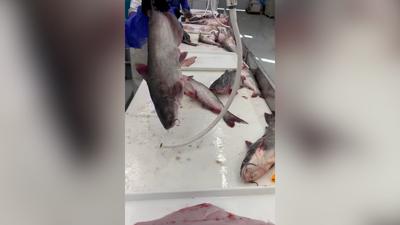
a s seen here it's a catfish processing plant that purchases catfish, filet's them, and ships them out to food banks.
"Off of Tilghman Island here, we're in the middle part of the bay. It seems like the catfish are more into the tributaries of the bay so we're buying catfish from about every body of water that you can imagine. It's nothing for these guys to go out and catch 2 to 20,000 pounds a day of blue catfish. At this plant here were able to process about 10,000 pounds a day," says Hargrove.
The governor has his sights set on these invasive species and the eastern shore watermen are hoping the governor's calls for federal help are answered.
Governor Moore's request for the disaster declaration was sent to the US department of commerce. That department will now formally review the governor's request to determine if Maryland is awarded any federal dollars to help out with the invasive fish problem in the bay.
But how did they get into the Chesapeake Bay?
The invasive blue catfish have been causing trouble for about 50 years. They were introduced in the 1970s by Virginia fisheries because they felt the Chesapeake Bay was "dead". The invasive fish made their way to the Eastern Shore about 20 years ago. However, it didn't take long for the problem to grow.
"They make up, in some tributaries of the Chesapeake Bay, about 70% of the biomass by weight. What that means is if you take a net and scoop all the life out of the bay and tributaries including the algae and the plants, the catfish make up 70% of that by weight," says Dr. Noah Bressman with Salisbury University.
The Department of Natural Resources is also looking for creative new ways to help combat northern snakeheads. They are calling on high school students to come up with ways to capture them. Officials say, in shallow and vegetated bodies of water it can be hard for traps or nets to catch the fish. Officials with the US Fish and Wildlife Service hope the combined brain power can help eliminate the northern snakeheads.
"As agencies alone we really can't remove enough to cause population control, but if we combine our efforts with efforts from the public we can hopefully see some tangible results," says Josh Newhard a fish biologist with the US Fish and Wildlife Service.
The deadline to submit a proposal is Saturday.
Newhard says that the proposals will go under review. A handful of them will get funding to be developed, and then officially get tested in the water.