
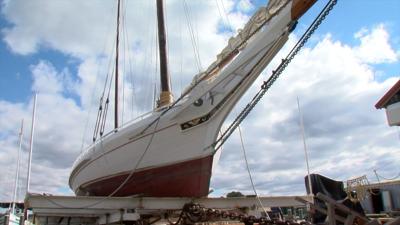
ST. MICHAELS, Md.- In 1889, Tilghman Island boat builder John B. Harrison launched a beautiful bugeye that captivated the town. The nine-log oystering boat, named Edna E. Lockwood, worked the bay for nearly 80 years.
Now 129 years later, and after a two-year-long renovation, the Edna E. Lockwood is ready to hit the waters again.
"It's been a challenge but we've taken it slow. A lot of hard work by a lot of people," says Joe Connor, lead shipwright of the project.
In 1973, the bugeye was donated to the Chesapeake Bay Maritime Museum by John R. Kimberly. Later on, in 1994, Edna E. Lockwood was named a National Historic Landmark, representing the last historic bugeye still under sail.
"It's a log canoe on steroids. A mix of the indigenous craft with the European style.," says Connor.
The restoration project started in 2016 and it was filled with challenges.
"We went step by step and we were very methodical," explains Connor. " We had the park services come in and they did a scan of the original boat. That gave us the dimensions of the trees that we needed. It took us close to two and a half years to find the proper logs."
After finding the logs, the long process of preparation and shaping started, trusting that technology would serve them well.
"There was a tense moment, as the crane was putting the top onto the new haul, to see if the scan was accurate and the parts would fit. They did and we're very happy with what we came up with," adds Connor.
Now after being re-launched during the 2018 Oyster fest, Edna will sail through the waters of the Chesapeake Bay next spring, this time with a new mission.
"Edna will be taking a red carpet tour around the bay," says Connor. "We're going to take her from Havre de grace to Norfolk and hit as many ports as we can. In April she'll be coming to a town near you," He added.
Reviving the spirit of the last boat of a forgotten fleet, to continue the legacy of traditional boat builders like Harrison.
"That's the dream of every artist, that your creation is going to last a really long time for a lot of people to see. I think what we've done here just pushed that another 100 years to the future," Connor added.