
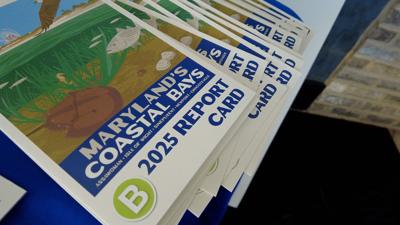


OCEAN CITY, Md. – The annual report card for the Maryland Coastal Bays Program earned a B for 2025, the second highest score the Coastal Bays has ever achieved.
The overall health of the bays earned a 66 on the scale that the program uses. This is one point less compared to the score for 2024, earning a 67. The assessment is conducted on the Assawoman, Isle of Wight, Sinepuxent, Chincoteague, and Newport bays, along with the St. Martin River.
The score is measured through six indicators. The four water quality indicators are dissolved oxygen, total nitrogen, total phosphorus and chlorophyll a. Seagrass and hard clams are the two biotic indicators. Researchers say chlorophyll a was the highest scoring indicator with an A+. Seagrass earned a D+ and hard clams earned a D, both remaining unchanged from last year.
Judy O’Neil, a research professor at the University of Maryland Center for Environmental Science, says seagrass played a huge part in why the score dropped by one point.
“What drove down the score for this year was a massive decrease of seagrass in Sinepuxent Bay,” she says. “83.5% decrease in seagrass from 2024 to 2025, which is a lot, and we're not sure why that happened. We’re going to have to investigate that, but it seems like temperature might be a factor.”
Carly Toulan, an environmental scientist with Maryland Coastal Bays, says it’s very important to maintain the bays in the area.
“A lot of people come to our watershed to vacation and enjoy the beaches and the bays and go boating,” she says. “If you don't have water that's fishable and swimmable and healthy, then folks can't come here and enjoy this beautiful place. Then, if you don't have healthy water quality, you lose so much of that diversity and amazing unique critters that live here that people also come to see. So, everything is connected.”
O’Neil says she has high hopes for the next report card grade.
“The fact that we are staying relatively steady overall with an increased population and the potential effects of climate change is good news that we're staying the course,” she says. “There's always variability from year to year. We're hoping that the data from 2026 will show some improvement in the seagrass, because if you look at the temperature for 2026, it was more normal. It wasn't above the average like it was in 2025.”
The Isle of Wight Bay was the most improved region, going from a C+ to a B-. The lowest scoring region was Newport Bay, maintaining a C- score. Seagrass levels had a failing grade in all sites except for the Chincoteague Bay.