
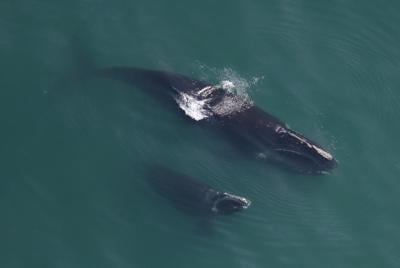

DELMARVA - A new federal lawsuit tied to the critically endangered North Atlantic right whale could possibly produce new complications for offshore wind development off Delmarva’s coast.
A coalition led by New Jersey-based nonprofit Save Long Beach Island filed suit this week in U.S. District Court in Washington, D.C., accusing the National Oceanic and Atmospheric Administration of failing to respond to a petition seeking expanded federal habitat protections for the migratory whales.
The lawsuit, filed on May 4 and obtained by WBOC, centers on a March 2025 petition asking NOAA to designate the whale’s “primary historical migratory corridor offshore” as critical habitat under the Endangered Species Act. The petition argues the federal government currently protects the whale’s feeding grounds in New England and calving grounds off the Southeast coast, but not the migration route connecting those areas.
That migration corridor includes Mid-Atlantic waters off Delaware, Maryland, and Virginia.
While framed as a whale protection case, the lawsuit heavily targets offshore wind development. Court filings repeatedly argue offshore wind construction and operation within the migration corridor could disturb whales through underwater noise, vessel traffic, and industrial activity.
Save Long Beach Island specifically seeks expanded critical habitat protections that they argue could help prevent offshore wind turbine construction and operation within parts of the migration corridor, potentially impacting proposed projects such as US Wind’s off the coast of Sussex and Worcester counties. New habitat protections could trigger additional environmental reviews, federal consultations, and permitting scrutiny for offshore wind projects in the region.
“The same cohort of [right whale] individuals that must navigate the offshore wind arrays in Maine, Massachusetts, and Rhode Island must also navigate the wind arrays off the coast of New York, New Jersey, Delaware, Maryland, Virginia, and North Carolina,” Save LBI writes in their petition.
“The migratory corridor of the [whales] represents the ecological connectivity of the endangered reproductive species. The unimpeded movement and the flow of natural processes that sustain its life should be a key factor in the conservation management of the right whale within their historical migration route.”
For Maryland and Delaware, Save LBI proposes a new migratory critical habitat corridor be established from 10 to 31 miles offshore. US Wind’s proposed project would fall into this range at about 11 miles.
Plaintiffs claim underwater noise from offshore wind construction and turbine operation could interfere with whale communication, navigation, and migration behavior for miles beyond wind-energy project sites. Federal agencies and offshore wind developers, however, have generally maintained there is no proven evidence directly linking offshore wind survey activity or turbine construction to recent whale deaths.
The lawsuit does not currently create any immediate restrictions for fishermen, boaters, or offshore projects. Instead, it seeks to force NOAA to formally respond to the petition process required under federal law.