
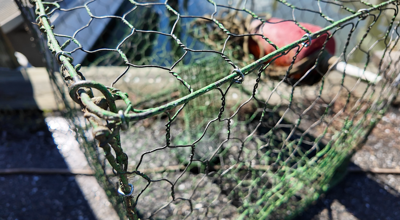

TALBOT COUNTY, Md. – An Easton-based environmental consulting firm has won federal money to pull abandoned crab pots, known as “ghost pots,” out of the Chesapeake Bay, and local watermen will be paid to do the retrieval.
According to the Virginia Institute of Marine Sciences, Rauch Inc. received $126,000 to recruit commercial watermen to recover derelict crab traps in Talbot County waters, including around Tilghman Island. The money comes through a NOAA subaward through the Virginia Institute of Marine Science.
Those areas were chosen based on a 2016 assessment by NOAA’s Marine Debris Program and the institute.The assessment predicts high levels of derelict pots off of Tilghman Island.
“These traps, and they don't stay there forever, first of all. But they can continue to trap other animals…,” Talbot County Watermen’s Association President Jeff Harrison said. “If I'm trot lining somewhere, netting, I mean, you get hung up and I mean it destroys your equipment, really.”
Harrison said crab pot lines, which are signaled by buoys, are sometimes cut off by boaters accidently. The pots can then drag off with that boat, making them hard for their owners to find. Left on the bottom, they can trap and kill marine life.
Chris Schoenster, who is leading the project for Rauch, said the work is new territory for the company.
“Using our boats, and we're gonna, we're going to buy a side scan sonar unit to survey the bottom,” Schoenster said. “And we're teaming up with the University of Delaware to take that data and process the data to automatically find and pinpoint and map the crab pots. The AI is trained to recognize a crab pot.”
The coordinates will then go to local watermen, along with additional sonar information equipment to help them zoom in on each pot’s location. The company said they plan to hire watermen in Talbot County for about two weeks, paying each about $400 a day plus fuel reimbursement.
Schoenster said field work is slated to begin with a sonar survey in January 2028 and end with a removal derby in March 2028, when commercial crabbing is closed in the bay.
“It gives an opportunity not only to clear out that pot so there's not continuing to catch other animals, but also it's an opportunity for the waterman to make a few dollars at a time of year when there's little to do here. So it's an opportunity for maybe a dozen boats or so to get some income,” Harrison said.
Harrison said a bay-wide cleanup was done about 12 to 15 years ago, paid for with blue crab disaster funds. He said “it was a lot of pots brought to shore,” but nothing has been done here since.
Schoenster said he hopes success in this pilot could convince Maryland to make the cleanup a statewide effort.