
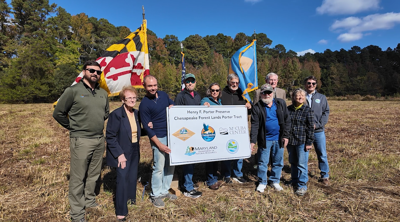

SEAFORD, Del. - Conservation partners gathered Friday to celebrate the permanent protection of 181 acres of forest and wetlands along the Nanticoke River and Wright Creek, land that spans the Maryland-Delaware line and took more than 15 years to preserve.
Maryland Department of Natural Resources Secretary Josh Kurtz called it the first time the two states have worked together on a land acquisition. Organizers say it is also the first two-state conservation effort in the entire Nanticoke watershed.
“It’s incredibly meaningful, because when we think about the protection work we do in Maryland, the benefits that we get to the bay would not be nearly as magnified if we didn’t see the same type of actions in our states that border us,” Kurtz said.
Who owns what
Two nonprofits, the Nanticoke River Watershed Conservancy (NRWC) and Chesapeake Conservancy, worked on the project for years. NRWC began trying to conserve the property more than 15 years ago, and Chesapeake Conservancy joined later.
Thirty-nine acres now belong to the state of Maryland and are part of its Chesapeake Forest Lands. The remaining 142 acres, including land in Sussex County, are owned and managed by the Nanticoke River Watershed Conservancy.
The U.S. Navy and Delaware’s Department of Natural Resources and Environmental Control, known as DNREC, co-hold a conservation easement that permanently protects the Delaware land.
Greg Patterson, secretary of DNREC, said the agencies contributed funding on the condition that the land remain open in perpetuity. Because the conservancy owns the land, he said, decisions about public access will be up to the group, though DNREC would support opening it up.
Why it matters
Patterson said the project stands out in a part of the state under heavy development pressure.
“In an area like Sussex County where the development just keeps coming and coming, everybody wants to see at least some trees, at least some fields, at least some rivers that are still in their natural state,” Patterson said. “And portions of this property look the same way they have for hundreds of years.”
He said the land also benefits the environment. Trees improve air quality, and open land and wetlands help water recharge and make water cleaner as it flows into the Nanticoke River and eventually the Chesapeake Bay, which he said officials have been working to clean up for more than 40 years. He also pointed to the Atlantic white cedar on the property, a tree he said DNREC is trying to conserve.
For Maryland, Kurtz said the Nanticoke is a special watershed.
“Ultimately, this is about protecting water quality for the Nanticoke River,” Kurtz said. “But from the perspective of Maryland, it’s just such a rare watershed because of some of the species that live there, primarily Atlantic sturgeon.”
Kurtz said the only place the sturgeon reproduce in Maryland is in the Marshyhope Creek, which feeds into the Nanticoke. The fish lay eggs in small gravel beds that excess sediment can cover. Keeping the land forested, he said, keeps sediment in place and helps protect the species.
“It’s sometimes a little bit hard to comprehend because we’re several miles up the river,” Kurtz said. “But at the end of the day, it’s these types of opportunities that are going to allow us to protect those things.”
He added that anyone living downstream benefits from cleaner water. On the Maryland side, he said, Chesapeake Forest Lands cover about 75,000 acres across the Eastern Shore and support recreation as well as the timber industry. He said the state is always looking to add to them, especially when the land is buffered by protected land in Delaware.
Why it took 15 years
Kurtz said deals like this depend on understanding the people who have a history with the land. Officials had to work with multiple family members and multiple partners, and each state has its own procurement process, which takes time to line up.
Patterson said the project required approaching multiple landowners and pulling together money from several sources, including the nonprofits, both states and the Navy. He said deed searches had to go back to the 19th century to clear up ownership.
“Once you get to the other side of it and you look around at this land and you see that it’s going to be here forever, with both the environmental benefits and the benefits to the public, it really is worth it,” Patterson said. He said it takes a few dedicated people to work through the challenges.
Kurtz said he hopes it is one of several projects the states do together.
Public access
Kurtz said the Maryland portion is public land. State forests are open for hiking, biking and hunting, he said, and details for each forest are available online through the Chesapeake Forest Lands. Patterson said he hopes public opportunities on the Delaware side will follow as the project moves along.