
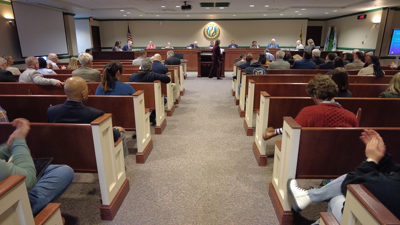

SNOW HILL, Md. - A Worcester County public hearing on a short-term rental parking rule drew a packed room Tuesday, as commissioners voted 6-1 to delay when an added parking requirement takes effect for some rental properties.
The issue before commissioners was Bill 26-01, a measure tied to the county’s short-term rental rules. The bill amends county code to modify the effective date for when short-term rental properties must provide one additional off-street parking space beyond the normal parking already required. The hearing was listed on Tuesday morning’s agenda as “Public Hearing Bill 26-01 Short-term Rentals Third Parking Space.”
On paper, the proposal was a narrow one. The bill does not eliminate the extra parking requirement. Instead, it changes when that requirement begins to apply. The introduced version of the legislation said the added parking space would be required for short-term rental structures with a building permit application received after Jan. 1, 2026.
But the discussion inside the commissioners room went well beyond parking.
Commissioner Eric Fiori said the matter was less about reopening the county’s broader short-term rental debate and more about correcting what he described as inconsistent oversight within county government. In an interview with WBOC after the vote, Fiori said some property owners had done their due diligence, received approvals and made investments, only to later face a rule that had not been uniformly applied.
“Sometimes we have to make these decisions to right wrongs, and the wrongs were done and we needed to right them,” Fiori said.
Supporters of the change argued some homeowners bought properties and planned to use them as short-term rentals under the belief that the county’s three-parking-space rule was not being enforced. They said delaying the effective date restores the understanding property owners had when they purchased and invested in those homes.
Others argued the issue is more complicated. Opponents said homeowners also have a responsibility to understand the rules of the communities where they buy property, including HOA bylaws that may be more restrictive than county policy.
The strong turnout showed how even a technical zoning matter can quickly become part of Worcester County’s larger fight over short-term rentals, property rights and neighborhood character. While Tuesday’s vote focused specifically on parking, the arguments from both sides made clear the broader debate is far from settled.
According to commissioners, the new date of enforcement is expected to be in mid-April of this year for new short-term rental property owners.