
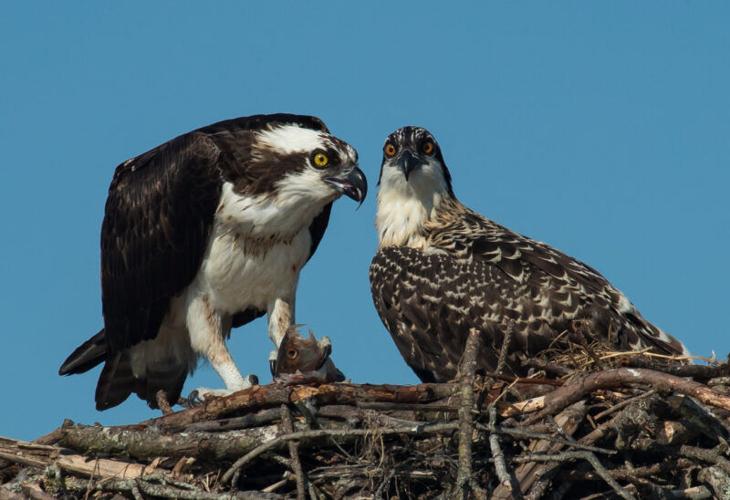


CHESAPEAKE BAY - Ospreys in the Chesapeake Bay experienced their worst breeding season on record in 2026, with researchers warning that widespread food shortages are threatening what has long been considered the world's largest breeding population of the iconic birds.
The Center for Conservation Biology at William & Mary says it monitored hundreds of osprey pairs throughout the Chesapeake Bay during the 2026 nesting season. Researchers found productivity in the saltier portions of the Bay had fallen to just 0.25 young per breeding pair, far below the rate needed to maintain a stable population.
According to the Center, osprey populations generally need to produce between 0.8 and 1.3 young per pair each year to remain stable. In salty tidal Chesapeake waters, 81% of the pairs monitored in 2026 failed to fledge a single chick, the study found. Of the pairs that did successfully produce young, researchers say 70% raised only one chick.
The decline has accelerated in recent years, according to scientists. Productivity in those tidal portions of the Chesapeake fell from 0.51 young per pair in 2024 to 0.35 in 2025 and 0.25 this year.
Researchers say the results are especially concerning as the Chesapeake Bay has long served as a global stronghold for the fish-eating raptors. Based on current reproductive rates, the Center estimates the Bay's breeding population could decline by an average of about 14% per year, potentially resulting in a 50% decline over the next decade if conditions do not change.
Food shortage suspected
While storms, predators, human disturbance, and extreme heat can all cause osprey nests to fail, researchers say the widespread failures seen in the Chesapeake in recent years show signs of something different: food stress.
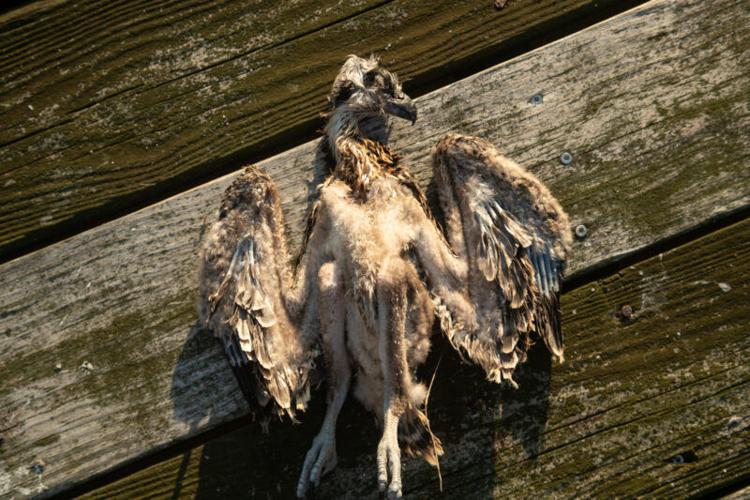
Scientists have documented low rates of fish being delivered to nests, underweight chicks, reduced brood sizes, and adult birds abandoning otherwise viable eggs or chicks. In some cases, researchers say they have observed young ospreys starving in their nests.

An emaciated osprey chick that starved on Mobjack Bay. Several recorded metrics as well as starved chicks indicate that the low productivity recorded in 2026 was driven by food stress. Photo by Bryan Watts, courtesy of The Center for Conservation Biology.
The Center says the problem appears closely connected to the availability of Atlantic menhaden, a small schooling fish that has historically been one of the Chesapeake osprey's most important sources of food.
In some portions of the Bay, researchers say the rate at which menhaden are delivered to osprey nests has declined by more than 80% since the 1980s. Changes in osprey diets have also resulted in an estimated 50% decline in the energy content of the food being brought to nests.
According to researchers, the reason for the reduced availability of menhaden remains unclear. Climate change, commercial fishing, changes in where the fish are distributed, and the timing of their arrival in Chesapeake waters are among the potential factors identified by the Center.
Ospreys need abundant fish during April, May, and June, when they are raising their young. Researchers say the birds cannot simply delay their breeding season if large numbers of menhaden do not enter the Bay until late June or July.
Chesapeake remains "Ground Zero"
Despite broader issues with osprey breeding along the Atlantic Coast, researchers describe the Chesapeake Bay as the center of the current reproductive crisis.
Of 16 study areas along the Atlantic Coast where osprey reproduction fell below 25% of the level needed to maintain a stable population, 15 were in the saltier portions of the Chesapeake Bay.
Researchers caution, however, that the findings do not mean ospreys are disappearing everywhere. Populations have recovered significantly from historic declines associated with the pesticide DDT, and ospreys remain secure across much of their overall range.
Instead, the Center says the struggles of coastal ospreys could serve as a warning about broader changes taking place in marine ecosystems.
Because ospreys sit near the top of the aquatic food web and depend heavily on fish, researchers consider them an important indicator of ecosystem health. The Center says the sharp decline in reproductive success along portions of the Atlantic Coast, especially in the Chesapeake Bay, raises concerns that extend beyond the birds themselves.
“Ospreys are apex predators and are considered to be effective indicators of aquatic ecosystem health,” The Center of Conservation Biology said. “Recent declines in reproductive rates raises a red flag on the health of marine ecosystems along portions of the Atlantic Coast.”