
WICOMICO COUNTY, Md. -- Wicomico leaders may pull their support from a project that has stirred up quite a bit of controversy. Rumors have been swirling online lately over a proposed biorefinery in Fruitland.
The proposal came from Morgan State University, a historically black research university in Baltimore, Maryland. Now, county leaders were initially on board with the proposal, but not in the way neighbors thought or the way this project has been portrayed on social media.
"I was very frustrated seeing the posts online saying there's another biorefinery, because that is not the case at all," said Julie Giordano, Wicomico County Executive.
Neighbors in Wicomico County are sensitive to the biorefinery topic. County leaders believe that's why the letter of support the county offered up for Morgan State University's proposal stirred up so much frustration, and it's why Giordano said she wants to set the record straight.
"I think there is a lot of miscommunication, a lot of things, a lot of assumptions made," said Giordano. "There is some fear after what happened, but we would never allow that to happen."
So... what is happening? Or perhaps the more apt question is: what happened to cause this social media firestorm?
It all began when Morgan State University reached out to Wicomico County for support in its efforts to obtain a Maryland Energy Administration Energy Grant.
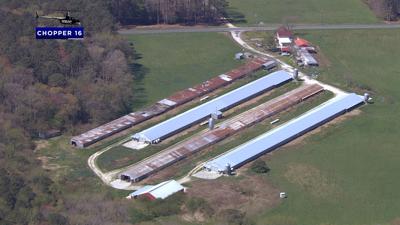
That grant would fund a small-sized Combined Heat and Power Unit at Bethel Farm, a poultry farm in Fruitland.
Project Scope:
Not every detail has been worked out yet, but Wicomico County provided us with a detailed breakdown it received from Dr. Seong Lee and Dr. Sam Alamu at Morgan State.
The team at Morgan State is proposing a small-scale, on-site energy system that would convert two local waste materials -- poultry litter from the farm and recyclable-grade municipal waste (MSW) from the Newland Park Landfill -- into clean heat and electricity for the poultry houses.
Poultry litter and shredded MSW would be dried and pressed into briquettes, which would then be heated in a low-oxygen chamber through a process called gasification to produce syngas.
The syngas would fuel a small engine connected to a generator to power the farm's lights, fans, and feeders.
"We thought, you know, hey, this is a really cool concept," said Giordano. "Anything to divert trash, you know, from the landfill is always a good thing."
Giordano said that's why the county initially offered up a letter of support.
However, this is nowhere near a done deal, and the county said it needs more information from Morgan State before moving forward.
"We're going to have an internal discussion as to what are the next steps, it could be that we potentially withdraw our support from the project altogether," said Giordano.
A final note here. This project is being proposed in an A-1 zoned area. Per the county's zoning laws, a biorefinery cannot be built in an A-1 zoned area.
So, even if Morgan State's project is classified as a biorefinery, it would not be allowed to be built near the neighborhoods that raised concerns.
Wicomico withdraws support
On Thursday, April 9, Wicomico County announced it was withdrawing its support for the waste diversion concept, saying the decision came after careful review and internal discussions.
"While the concept presented potential benefits—including landfill diversion, methane reduction, and alignment with broader clean energy goals—County leadership has determined that there are still too many unknowns regarding logistics, environmental considerations, and overall feasibility to offer our support at this time," the county said in a statement.
County officials underscored that the project was not a biorefinery, but a limited, small-scale concept. It would not have involved large-scale industrial processing, commercial fuel production, or the development of a standalone facility.
“This was simply an early-stage concept focused on exploring innovative ways to manage waste and reduce landfill dependence,” County Executive Giordano said. “However, after further internal evaluation, we believe it is prudent to step back until more detailed information and analysis are available.”