
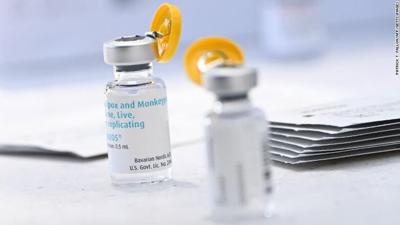
DOVER, Del. - The Delaware Division of Public Health on Monday announced upcoming opportunities for individuals to get vaccinated against the monkeypox virus.
The current case count for monkeypox in the state is 33, including 22 cases in New Castle County, two cases in Kent County, and nine cases in Sussex County. Delaware continues to offer vaccinations to people at a higher risk of exposure.
DPH and Beebe Healthcare are partnering with AIDS Delaware and the Delaware HIV Consortium to offer monkeypox vaccination during the Sept. 17 AIDS Walk events in New Castle and Sussex counties. The AIDS Walk events are being held at Brandywine State Park in Wilmington and in Grove Park in Rehoboth Beach. Individuals do not need to be registered for the walk to be vaccinated. Pre-registration to receive the vaccine at the Brandywine State Park location with DPH can be done by calling the monkeypox hotline at 866-408-1899. It is operational Monday – Friday from 8:30 a.m. to 4:30 p.m. Vaccinations will be administered between 9 a.m. and 12:30 p.m. The vaccine is free.
Pre-registration is not required for vaccination at the Rehoboth Beach event with Beebe Healthcare, being held between 9 a.m. and noon. Staff will provide onsite assistance to schedule second doses. Individuals should bring their ID and insurance card. While the vaccine is free, there may be an administration fee (less than $30), which typically is covered by insurance, but may be billable to a patient without insurance coverage.
Additional details about the AIDS Walk itself can be found at: https://aidsdelaware.salsalabs.org/2022AIDSWalkDelaware/index.html.
DPH is also announcing that it is expanding vaccine access to those deemed to be at a higher risk for monkeypox infection such as those treated for a sexually transmitted infection in the last six months, people experiencing homelessness, those who are incarcerated, or individuals traveling to an area with community spread of MPX cases. Currently, the Centers for Disease Control and Prevention is not encouraging vaccination against monkeypox for the broader public or for everyone who is sexually active.
Vaccines are also available to those at highest risk including:
- Those confirmed to have been exposed to someone with the virus
- Persons known or presumed to be exposed to someone with monkeypox in the last 14 days
- Certain individuals who have sex with men and who have had multiple sex partners within the past 14 days
- Those living with HIV or who are receiving HIV PrEP
- Immunocompromised persons (including those with cancer, solid organ or stem cell transplants, those taking immunosuppressive therapy, and individuals with autoimmune disease)
- Those engaging in high-risk activities, including sexual practices, that increase exposure to monkeypox, such as:
- Gay, bisexual, and other men who have sex with men and have had multiple, or any, anonymous sexual partners in a social network experiencing monkeypox activity, this includes meeting partners through an online website, digital application (“app”), or social event (e.g., a bar or party)
- Transgender women or nonbinary persons assigned male at birth who have sex with men
- Sex workers (of any sexual orientation/gender)
- Staff (of any sexual orientation/gender) at establishments where sexual activity occurs (e.g., bathhouses, saunas, sex clubs)
Individuals should be aware that the vaccine, a two-dose series given 28 days apart, is not considered effective until two weeks after the second dose. Those at higher risk should continue using preventive measures and reduce engaging in high-risk behaviors both prior to, and after, vaccination to reduce the chance of continued spread of monkeypox in the community.
Eligible Delawareans may also receive monkeypox vaccinations at:
- Newark Urgent Care - Visit NewarkUrgentCare.org to view eligibility requirements and schedule an appointment. Vaccine clinics are on Thursdays, and there is no cost for the vaccine.
- Beebe Healthcare: Individuals can schedule an appointment at beebehealthcare.org/online-scheduling. Walk-ins will not be accepted.
- DPH clinics: Individuals should call the monkeypox hotline at 866-408-1899 for a screening evaluation. Walk-ins at DPH clinics will not be accepted. Monkeypox vaccinations at DPH clinics will continue to prioritize individuals at highest risk, as a result of confirmed or potential exposure to someone with monkeypox. As a result, your appointment may be scheduled a few days out.
Signs and Symptoms
The symptoms of monkeypox are similar to but milder than the symptoms of smallpox. Symptoms usually start within three weeks of exposure to the virus. Most people who contract monkeypox will develop a rash, and some will develop flu-like symptoms beforehand. The flu-like symptoms may include fever, headache, muscle aches and backache, sore throat, cough, swollen lymph nodes, chills, or exhaustion. If someone has flu-like symptoms, they usually will develop a rash one to four days later.
If you suspect you are experiencing any symptoms associated with MPX you should immediately:
- Contact your health care provider and discuss your symptoms and concerns.
- Self-isolate until all lesions have resolved, the scabs have fallen off, and a fresh layer of intact skin has formed.
- Avoid being intimate with others.
- Make a list of your close and intimate contacts in the last 21 days.
It can take three to four weeks for all symptoms to fully heal. While there is no specific treatment for MPX, antivirals can be prescribed, though they are not always needed. To learn more information about monkeypox, please visit de.gov/monkeypox. DPH began posting monkeypox case and vaccine data on the website last week.
DPH launched a hotline for individuals with questions or concerns about monkeypox. The hotline number is 866-408-1899 and is operational Monday –Friday from 8:30 a.m. to 4:30 p.m. Questions may also be emailed to DPHCall@delaware.gov. Both the hotline number and email address share staff with the COVID-19 Call Center. To learn more about monkeypox prevention programs and resources, visit de.gov/monkeypox.